If you’ve been asking yourself, “How much does dental SEO cost?” you’re in good company. This is one of the most common questions dentists are asking right now, especially as the industry shifts and more practices start looking for predictable ways to attract new patients without relying entirely on referrals or insurance networks.
The challenge is that most answers you find online are either overly vague or unrealistically simplified. You’ll see everything from “SEO is cheap” to “you need to spend thousands per month,” without much explanation as to why. The reality sits somewhere in the middle, and it’s a lot more nuanced than a flat number.
This guide is meant to give you a clear, honest look at what dental SEO actually costs, what drives those costs, and what you should realistically expect in return. By the end, you should have a much better sense of what makes sense for your practice and your growth goals.

Why Dental SEO Pricing Isn’t One-Size-Fits-All
Before jumping into numbers, it’s important to understand why dental SEO pricing varies so much. Unlike something like direct mail or a one-time ad campaign, SEO is an ongoing strategy that depends heavily on your starting point and your environment.
For example, a practice in a smaller town with limited competition is going to require a completely different level of effort than a practice in a densely populated area with dozens of nearby competitors. If there are 40 or 50 dentists in your immediate area all trying to rank for the same services, the amount of work required to stand out increases significantly.
Your current dental website also plays a major role. Some practices already have a strong foundation with decent content, good structure, and a solid online presence. Others may have a website that looks fine visually but is missing key elements that both search engines and AI tools rely on to understand and recommend a business. In those cases, more work is needed upfront to rebuild that foundation before you ever start seeing meaningful results.
The types of services you want to promote matter as well. Ranking for general dentistry or cleanings is very different from trying to dominate searches for high-value procedures like dental implants or full smile makeovers. Higher-value services tend to be more competitive, which naturally increases the level of strategy and investment required.
What Dentists Are Actually Paying for SEO
When most dentists think about SEO, they think about rankings. But what you’re really paying for is a combination of strategies working together to make your practice more visible, more credible, and more likely to convert visitors into patients.
A large portion of the investment goes into content creation. This includes service pages that clearly explain what you offer, blog content that answers real patient questions, and detailed FAQ sections that help both search engines and AI tools understand your expertise. This is especially important today, because patients are no longer just typing in short keywords. They’re asking full questions like, “How long do dental implants last?” or “Is Invisalign better than braces?” The practices that answer these questions clearly are the ones that get recommended.
Another major component is local SEO. This is what helps you show up when someone searches for a dentist in your area or when AI tools generate local recommendations. It includes optimizing your Google Business Profile, ensuring your information is consistent across directories, and building local relevance so your practice is seen as a trusted option in your community.
There’s also technical SEO, which is the behind-the-scenes work that most dentists never see but absolutely feel the impact of. This includes things like website speed, mobile usability, proper indexing, and overall site structure. If these elements are off, it can limit your visibility no matter how good your content is.
Finally, there’s authority building. Search engines and AI tools both look for signals that your practice is credible and trustworthy. This includes backlinks from reputable sources, strong patient reviews, and a consistent online presence. Without these signals, it becomes much harder to stand out, especially in competitive markets.

How Much Does Dental SEO Cost?: The Real Cost of Dental SEO (What to Expect)
Now that you understand what goes into it, let’s talk about what dentists are actually investing.
At the lower end, you’ll typically see services ranging from around $500 to $1,500 per month. This level often includes basic optimization, limited content updates, and some foundational work. While this can be a starting point for practices in less competitive areas, it usually isn’t enough to create significant, long-term growth in most markets.
In the mid-range, which is where many growing practices find themselves, the investment typically falls between $1,500 and $3,500 per month. At this level, you should expect a more consistent and strategic approach. This includes regular content creation, ongoing optimization, local SEO efforts, and a clearer focus on generating actual patient inquiries rather than just improving rankings.
For practices in highly competitive areas or those looking to aggressively grow, investment levels often move into the $3,500 to $7,000+ per month range. This is where dental SEO becomes a fully integrated growth strategy. It involves deeper content development, stronger authority building, conversion optimization, and alignment with other marketing channels to maximize results.
It’s important to note that these are general ranges, not fixed pricing. The goal isn’t to find the lowest number possible, but to understand what level of investment is required to achieve the results you’re aiming for.
Is Dental SEO Actually Worth the Investment?
This is where most dentists hesitate, and it’s a fair question. On the surface, spending a few thousand dollars per month can feel like a big commitment. But the real way to evaluate SEO is by looking at the return.
If your SEO strategy brings in even 20 to 30 new patients per month, the production value can easily outweigh the cost, especially when those patients are coming in for higher-value procedures. Unlike paid ads, where results stop the moment you stop spending, SEO builds over time. The work you do today continues to generate visibility and leads in the future.
Another way to look at it is through opportunity cost. If your competitors are investing in SEO and showing up when patients are actively searching for care, those are patients who could have chosen your practice but didn’t. Over time, that gap can become significant.

How AI Search Is Changing the Way Patients Find Dentists
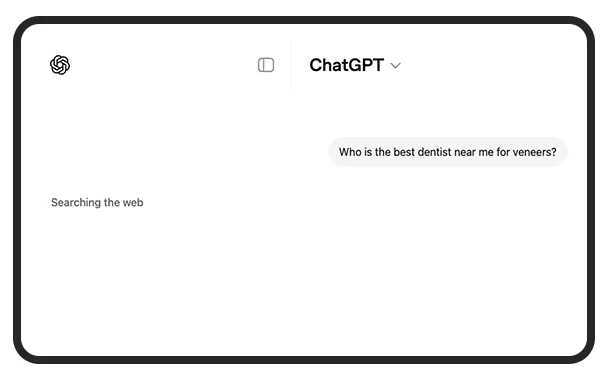
One of the biggest shifts happening right now is how patients search for information. Instead of just Googling “dentist near me,” many are turning to AI tools and asking more specific questions. They might ask, “Who is the best dentist near me for veneers?” or “What’s the average cost of Invisalign in my area?”
The difference is that AI tools don’t show a list of ten options. They typically recommend one or two providers based on the information they can find and understand. That means your online presence needs to do more than just exist. It needs to clearly communicate your expertise, your services, and your credibility in a way that AI can easily interpret.
This is why modern SEO strategies focus heavily on clear, conversational content and strong authority signals. It’s not just about ranking anymore. It’s about being the practice that gets recommended.
What Should You Actually Budget for Dental SEO?
A good way to approach budgeting is to think about your goals and your market. If you’re in a less competitive area and just getting started, a lower investment might be enough to build momentum. If you’re in a competitive market or trying to grow quickly, you’ll likely need to invest at a higher level to see meaningful results.
It’s also important to think long-term. SEO is not a quick fix. It’s a strategy that builds over time, and the practices that see the best results are the ones that commit to it consistently rather than treating it as a short-term experiment.
The key is to focus on value rather than cost. Affordable dental patient acquisition doesn’t mean choosing the cheapest option. It means investing in a strategy that consistently brings in the right patients at a cost that makes sense for your practice.
Where Most Dental SEO Strategies Fall Short
One of the biggest mistakes dentists make is approaching SEO as a checkbox instead of a growth strategy. They hire a provider, expect immediate results, and focus only on rankings rather than actual patient outcomes.
The reality is that rankings alone don’t grow a practice. You need the right traffic, the right messaging, and a website that converts visitors into patients. If any of those pieces are missing, you can end up in a situation where your site gets traffic but your phone doesn’t ring.
This is also where many lower-cost SEO services fall short. They may focus on basic optimizations without addressing the bigger picture, which leads to frustration and the perception that SEO doesn’t work.
Final Thoughts: What This Means for Your Practice
At the end of the day, the cost of dental SEO comes down to what you’re trying to achieve. If your goal is simply to have an online presence, you can likely get by with a minimal investment. But if your goal is to consistently attract new patients, grow your revenue, and stay competitive as the industry evolves, SEO becomes a much more strategic investment.
With the rise of AI search for dentists, this is only becoming more important. Patients are looking for clear answers and trusted recommendations, and the practices that provide those are the ones that stand out.
Want to See What This Looks Like for Your Practice?
If you’re wondering how your current SEO strategy stacks up, or what it would take to start generating more consistent patient flow, the best next step is to take a closer look at your specific situation.
At Firegang Dental Marketing, best dental marketing company for dentists, we focus on more than just rankings. We look at what actually drives new patients and long-term growth for your practice.
Schedule a complimentary practice growth assessment call, and we’ll walk you through where you stand today, what opportunities exist, and what a realistic path forward could look like. No pressure, just clear insights you can actually use.