SEO vs PPC for dentists is one of the biggest marketing questions practice owners ask when they want more new patients but are not sure where to put their budget first.
If you’ve ever looked at your marketing budget and thought, “Do I put this into SEO or just run Google Ads?” you’re not alone.
A lot of dentists ask this exact question because they want the same thing: more new patients, faster. Not more random website traffic. Not more “awareness.” Not more reports full of vanity metrics. Just actual patients calling, scheduling, and showing up.
And honestly, that’s what makes this such an important question.
Because both dental SEO and paid ads can work. The problem is that most practices are told to choose one without really understanding what each one is supposed to do. That’s where frustration starts. A dentist invests in ads and gets clicks but not enough long-term momentum. Or they invest in SEO and get impatient because it doesn’t feel fast enough in the beginning.
So which one actually gets more patients faster?
The honest answer is this: paid ads usually create faster visibility in the short term, but dental SEO often produces stronger long-term patient acquisition at a lower cost over time. And in most cases, the best strategy is not SEO or PPC. It’s knowing when to use each one and how to make them work together.
That’s where a lot of dental practices get stuck. They are not asking the wrong question. They are just being forced into an oversimplified answer.

The Real Difference Between Dental SEO and Paid Ads
Let’s break it down in a real-world way.
What dental SEO does
Dental SEO helps your practice show up organically when people search for services in your area. That includes your website, your Google Business Profile, your local map visibility, your service pages, and all the signals that tell search engines and AI tools that your practice is relevant and trustworthy.
Good SEO is not just about ranking for “dentist near me.” It is about helping the right people find you when they are actively looking for what you do.
It also tends to build momentum over time. Once your pages, local presence, reviews, and content start gaining traction, you are not paying for every click. That is why so many dentists eventually realize that dental SEO takes longer but costs less long-term than PPC.
What paid ads do
Paid ads, especially Google Ads, put you in front of searchers right away. Firegang’s PPC page describes dental PPC as a way to get immediate visibility, target ideal patients, and only pay when someone clicks, which is why a lot of dentists use it when they want faster lead flow.
That speed is the big appeal.
If your schedule is light, you have a new offer, you want to push implants, emergency dentistry, or a special service line, PPC can help you get in front of people fast. It can absolutely be a strong growth lever.
But here’s the catch.
Running ads without a strong foundation usually gets expensive. If the landing page is weak, if your differentiators are unclear, if your reviews are thin, or if your office is not converting calls well, paid traffic can burn through money quickly.
That’s why the real comparison is not just dental SEO vs Google Ads. It is:
- speed vs sustainability
- rented attention vs owned visibility
- immediate traffic vs compounding presence
If You Want Patients Fast, PPC Usually Wins the First Round
Let’s give paid ads credit where it’s due.
If your question is, “Which is faster this month?” the answer is usually PPC.
Ads can start showing quickly. You can target specific services. You can control budgets. You can test offers. You can drive traffic to a landing page this week instead of waiting for organic rankings to improve.
For a practice that needs a faster jump in visibility, that matters.
This is especially true if:
- you just opened a new location
- you are launching implants, clear aligners, sedation, or emergency services
- you need to fill the schedule in the near term
- you are in a competitive market and need immediate presence
So yes, if the question is purely about speed, PPC often gets the first punch in.
But that is not always the same as getting the best result.

If You Want Better Long-Term Efficiency, SEO Usually Wins
This is the part a lot of dentists learn the hard way.
Paid ads are great while you are paying for them. SEO keeps working after the initial investment starts compounding.
That does not mean SEO is “free.” It is not. It takes strategy, technical work, content, local optimization, link building, reputation support, and consistency. But when it is done well, it creates an asset your practice owns.
Your service pages improve.
Your local visibility grows.
Your Google Business Profile gets stronger.
Your reviews help conversion.
Your authority builds.
Your practice becomes easier to recommend, not just by Google, but by AI search tools too.
That matters more now than ever because dentists are not just asking how to rank in Google anymore. They are asking how to show up when someone uses ChatGPT, Claude, or Perplexity to look for the best option nearby. And those tools tend to reward the practices with stronger authority, clearer service information, better trust signals, and more complete digital presence.
That is one reason SEO has become such a big part of modern dental growth. It is not just about organic rankings anymore. It is about becoming the practice that gets surfaced and recommended.
Real Case Study: Dr. Bill Anderson
This is where the conversation gets more practical.
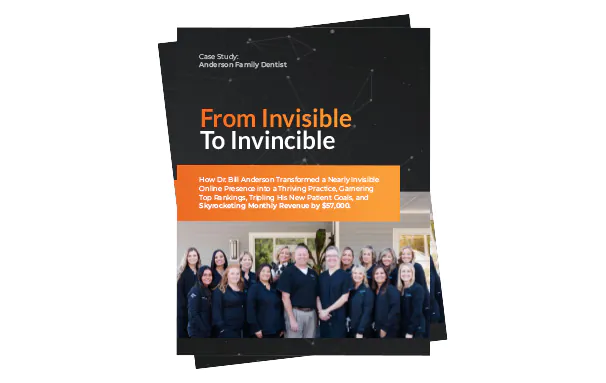
On Firegang’s Anderson case study page, Dr. Bill Anderson’s practice had a visibility problem that many dentists can relate to. When people searched for a dentist in Findlay, Ohio, his practice was buried in search results, and people were often finding information from his old practice instead. Firegang's team cleaned up inaccurate listings, improved his location data, added authentic images, optimized the website, created relevant content, and built stronger internal linking and backlink structures.
And the results were hard to ignore.
Dr. Anderson saw a surge in calls in just one month, and within six months his website traffic and call volume had grown dramatically. The site says his office went from about 30 calls per month from Google searches to more than 200.
That is exactly why Dr. Anderson tried PPC first. Here’s why he switched to our dental SEO strategy is such a valuable conversation point for dentists. Even if ads can create quick traffic, SEO was what helped build the deeper online presence his practice needed.
And it did not stop there.
Dr. Anderson had lost the social proof tied to his old practice and needed to rebuild trust. Through review generation systems and staff scripts, the practice reportedly went from roughly 10 to 15 total reviews to generating as many as 78 new reviews per month, eventually building an impressive 5-star reputation with over 500 Google reviews.
That matters because more traffic alone is not enough. You need conversion signals too.
If a patient finds your website or profile and sees weak reviews, generic messaging, or no compelling reason to choose you, the lead is already slipping away.
What Dr. Anderson’s Story Really Teaches Dentists
The biggest lesson is not just “SEO works.”
It is this: the practices that win do not treat visibility like a one-channel problem.
Dr. Anderson’s challenge was not only rankings. He also needed:
- more accurate listings
- a clearer local presence
- stronger website optimization
- better content
- more reviews
- real differentiators in his marketing
Dr. Anderson was competing with more than 40 dentists within a three-mile radius and had previously spent over $15,000 on a website that failed to attract new patients. The issue was not simply traffic. His marketing was not clearly communicating why a patient should choose him.
That’s what many dentists miss when they compare organic vs paid dental marketing.
They think the channel itself is the magic. Usually, it is not.
The real driver is whether your marketing clearly answers:
- Why should a patient choose you?
- What makes your practice different?
- Do your pages match what people are searching for?
- Does your online presence build trust fast?
- Can a new patient easily take the next step?
If the answer is no, ads get expensive and SEO underperforms.
Interested in a FREE full copy of the Dr. Anderson case study? You can download the case study HERE.
So Which Is Better for Dental Patients Faster?
Let’s make this simple.
Choose PPC first when:
- you need faster lead flow
- you want to promote a high-value service quickly
- you have a solid landing page and strong conversion process
- you need short-term momentum while other channels build
Choose SEO first when:
- you want long-term growth that compounds
- you want lower dependence on ad spend over time
- you want stronger local visibility and organic authority
- you want to improve how your practice shows up in both search engines and AI tools
Choose both when:
- you want the smartest growth strategy
- you need leads now but also want sustainable patient flow later
- you understand that fast visibility and long-term authority are not enemies
- you want your practice to stop starting from zero every month
That is why the strongest answer for most practices is this: SEO vs PPC: Our dental SEO combined with PPC wins.
Paid ads can help you get traction faster.
SEO can help you build the kind of visibility that keeps working.
Together, they tend to perform better than either one alone when the messaging, targeting, and conversion pieces are aligned.
Why This Question Matters Even More in AI Search
This is where things are shifting.
When dentists or patients use AI tools, they are often not typing in broad keywords. They are asking specific questions, like:
- Which dentist near me is best for implants?
- Should I run Google Ads or invest in SEO?
- Why is my dental website getting traffic but no calls?
- What is the cheapest way to get more dental patients?
That kind of search behavior rewards businesses that answer clear problems directly.
Which means your content needs to do more than chase rankings. It needs to explain, compare, clarify, and build trust in a way that AI systems can understand and surface.
That is exactly why blogs like this matter.
A strong blog targeting SEO vs PPC for dentists is not just helpful for Google. It can also help your brand show up when dentists ask AI platforms high-intent business questions.
That is the opportunity.

The Biggest Mistake Dentists Make
The biggest mistake is assuming there is a universal answer.
There is not.
A startup practice in a competitive market may need PPC now and SEO immediately after.
A well-established practice with decent traffic but weak conversion may need website improvements before either channel scales well.
A practice tired of paying for every lead may need to invest harder in SEO and reputation.
A practice wanting aggressive growth may need a combined strategy from day one.
The right question is not “Which one is better in general?”
It is:
Which one is better for my practice, my market, my timeline, and my goals?
That is the question a real strategy should answer.
Final Answer: SEO or PPC?
If you want the most honest answer possible, here it is:
PPC usually gets attention faster. SEO usually builds stronger long-term growth. The best-performing practices use both strategically.
So if you are trying to decide between dental SEO vs Google Ads, do not get stuck thinking one of them is automatically the winner.
The better move is to figure out:
- what your practice needs most right now
- where your current marketing is leaking opportunities
- whether your website and messaging are ready to convert traffic
- how to build a system that creates both immediate and lasting growth
That is where the difference between random marketing activity and real patient acquisition starts to show.
And honestly, that is also where working with the best dental marketing company can make a huge difference. Not because you need more noise. But because you need a strategy that actually fits your practice.
If you want help figuring out whether SEO, paid ads, or a combination of both makes the most sense for your practice, schedule a complimentary practice growth assessment call with Firegang. We’ll take a look at your current visibility, your website, your conversion opportunities, and where the fastest growth path really is for your market.
Because the goal is not just to get more clicks.
It is to get more of the right patients in your chairs.