AI search optimization for dentists is quickly becoming just as important as traditional dental SEO, especially as patients use ChatGPT and Google AI tools to research treatments before they ever visit your website.
Let's say a potential patient opens ChatGPT tonight and types: "Who offers Invisalign in [your city] and can tell me how long it takes?"
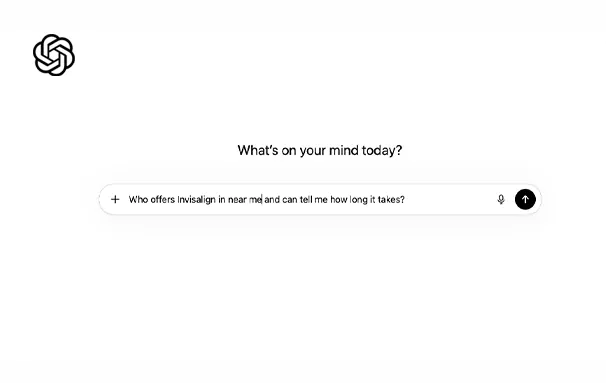
Your practice offers Invisalign. You've had an Invisalign page on your website for years. You've invested in dental SEO. And yet — there's a real chance your practice doesn't come up at all.
Not because you did something wrong. Not because your competitors are cheating the system. But because the way most dental service pages are written makes them effectively invisible to AI tools, even when those pages rank reasonably well in Google.
Here's what's actually happening, why it matters, and — the good news — exactly how to fix it in about 30 minutes per page.
The "Call Today" Trap
Open your Invisalign page right now. Or your implants page. Or your teeth whitening page. Read the first few paragraphs as if you're a patient who knows nothing about the procedure.
There's a good chance what you'll find looks something like this:
"At [Practice Name], we are proud to offer Invisalign clear aligners to help you achieve the straight, beautiful smile you've always wanted. Our experienced team will design a customized treatment plan tailored to your unique needs. Call today to schedule your free consultation."
That copy isn't wrong. But from an AI search perspective, it's almost completely worthless.
Here's why. When ChatGPT is deciding whether to reference your Invisalign page in a response, it's evaluating whether your content actually answers the question a patient asked. A page that's built around "call today" and "customized treatment plans" and "beautiful smile you've always wanted" doesn't answer anything. It describes a feeling. It makes a promise. It invites action.
But it doesn't explain how Invisalign works. It doesn't say how long treatment takes. It doesn't address whether it hurts. It doesn't discuss cost or insurance or what happens at the first appointment.
AI tools are not impressed by marketing language. They're looking for information. And if your page doesn't have substantive information, it has nothing to offer — regardless of how well it might rank in a traditional Google search.
This is the "call today" trap: service pages written entirely to convert the visitor who's already ready to book, while failing completely to inform the visitor who's still researching. In a world where AI search is part of how patients research, those uninformed visitors are increasingly the ones who never even make it to your dental website.
The 6 Questions Every Dental Service Page Must Answer
To be visible in AI search, a service page doesn't need to be a dissertation. It needs to answer the questions that patients are actually asking. There are six of them that come up consistently across every procedure — and every service page should address all six, clearly and directly.
-
Who is a good candidate for this procedure?
Patients want to know if this is even relevant to them before they dig deeper. A sentence or two that describes who this treatment works best for — and who might not be a good fit — immediately makes your content more useful and more citable.
-
What does the process actually involve?
Step-by-step, plain English. Not "we'll design a customized treatment plan." What happens at the first appointment? What happens next? How many visits does it typically take? Patients want to picture themselves going through the process before they commit to a consultation.
-
Is it painful?
This question is typed into Google and ChatGPT constantly. "Is Invisalign painful?" "Does getting a dental implant hurt?" "How bad is a root canal really?" If your page doesn't answer it, some other page will — and that other page might be the one that gets cited.
-
How long does treatment take?
Timeline is one of the top three questions for almost every elective or restorative dental procedure. Patients are planning around their lives. Give them a real answer, even if it's a range.
-
What does it cost, and what affects the price?
You don't have to publish a price list. But acknowledging that cost depends on certain factors, giving a rough range if possible, and explaining what financing or insurance options exist — that's the kind of answer that builds trust and makes your content genuinely useful. "Call for pricing" is not an answer to the cost question.
-
What is recovery like?
For anything beyond a routine cleaning, patients are worried about what happens after. How long before they can eat normally? Go back to work? Work out? The more specifically you answer this, the more valuable your content becomes to someone who is seriously considering treatment.
A service page that addresses all six of these questions isn't long for the sake of being long. It's complete. And completeness is exactly what AI tools are trained to reward.
Before and After: A Real Invisalign Page Rewrite
Here's what the difference actually looks like in practice. Not in abstract terms — in real copy.
Before (typical Invisalign page):
We offer Invisalign clear aligners as a comfortable, discreet alternative to traditional braces. Perfect for busy adults and teens, Invisalign fits seamlessly into your lifestyle. Call our office today to schedule your complimentary consultation and find out if Invisalign is right for you.
Word count: 46. Questions answered: 0. AI visibility: essentially none.
After (AEO-ready Invisalign page section):
Who is Invisalign a good fit for? Invisalign works well for adults and teens dealing with mild to moderate crowding, spacing, or bite issues. It's especially popular with patients who want a discreet option and are committed to wearing their aligners 20–22 hours a day. During your consultation, we'll take a close look at your bite and let you know whether Invisalign or another orthodontic approach would give you the best result.
How long does Invisalign take? Most patients complete Invisalign treatment in 12 to 18 months, though simpler cases can move faster. We'll give you a more specific timeline after your initial assessment.
Does Invisalign hurt? Most patients experience some pressure or mild discomfort during the first few days of each new set of aligners — your teeth are moving, after all. But the majority of patients describe it as very manageable, especially compared to traditional braces. Over-the-counter pain relievers are usually more than enough if needed.
What does Invisalign cost in [City], and does insurance cover it? Invisalign costs vary based on the complexity of your case and the length of treatment. Many dental insurance plans with orthodontic coverage apply to Invisalign, and we also offer financing options to help spread the cost over time. We'll go over all of this in detail at your consultation so there are no surprises.
Word count: 246. Questions answered: 4 out of 6. AI visibility: dramatically higher.
The second version gives an AI tool real, specific, patient-relevant content to cite. The first one gives it nothing. And the rewrite probably took 20 minutes.
How to Add a 30-Minute FAQ Block to Any Existing Service Page
You don't have to rewrite your entire service page to start moving in the right direction. The fastest, highest-impact change you can make is to add a structured FAQ block at the bottom of any existing page.
Here's the process:
Step 1: List the six questions above as your starting framework, customized for the specific procedure. For a dental implant page: "Who is a good candidate for dental implants?" "How long does the implant process take?" "Are dental implants painful?" "How much do dental implants cost?" "What is recovery from dental implant surgery like?" "How long do dental implants last?"
Step 2: Write a genuine answer to each one. Not marketing language — the answer you'd give a patient sitting in your chair who just asked the question out loud. Conversational, specific, honest. Two to five sentences per answer is usually enough.
Step 3: Format them as actual Q&A. Use the question as a bold header and put the answer directly below it. This format isn't just readable — it's exactly the structure that schema markup (specifically FAQPage schema) is designed to surface to AI tools and search engines as discrete, citable content.
Step 4: Ask your web team to add FAQPage schema to the updated page. This is a technical step that takes a developer maybe 15 minutes, and it tells AI tools explicitly that this section of your page contains questions and answers worth referencing.
That's it. One FAQ block, structured properly, added to your top two or three service pages. That's a meaningful improvement in AI visibility that most of your competitors haven't made.
What to Put in Your Page Title and H1 to Get Cited
This is a detail that's easy to overlook but worth getting right.
AI tools pay attention to how you label your content — what your page title says, what your main heading says, and whether those things align with the questions patients are actually asking.
A page titled "Invisalign | [Practice Name]" is about your practice. A page titled "Invisalign in [City]: Cost, Timeline, and What to Expect" is about the patient's question.
The second version is far more likely to get picked up by an AI tool because it signals from the very top of the page that this content is organized around answering real patient questions. The phrase "cost, timeline, and what to expect" mirrors exactly how patients phrase their searches — and exactly what AI tools are trained to look for when evaluating whether a page is worth citing.
The same principle applies to your H2 subheadings throughout the page. Rather than "Our Invisalign Process," try "What Does the Invisalign Process Look Like, Step by Step?" Rather than "Invisalign Benefits," try "Why Do Patients in [City] Choose Invisalign Over Braces?" These small shifts in framing — from describing your practice to answering patient questions — compound across every page on your site.
The Bigger Picture: AI Search Optimization for Dentists
A single service page rewrite is a start. But the practices that consistently show up in AI recommendations are the ones who've made this kind of question-answering content the standard across their entire website — not a one-time project, but the ongoing expectation for every page they publish.
That means every major service page has the six core questions answered. Every page has a structured FAQ block. Every page is titled and headed in a way that mirrors real patient language. And the whole thing is built on a technically sound foundation with proper schema markup.
It sounds like a lot, but it's really just a different way of thinking about what your website is for. Not a brochure. Not a billboard. A resource that answers the questions your future patients are already asking — somewhere. The only question is whether they're finding those answers on your site or on a competitor's.
Thirty minutes per page is where it starts. A fully optimized website is where it ends up.
Our free ChatGPT guide includes a copy-and-paste prompt that can rewrite any service page in under 10 minutes — no copywriting experience required. You'll find the full walkthrough, along with the complete 4-part process for making your practice AI-ready, inside: How to Make Your Dental Practice Show Up in ChatGPT.
If you'd like a professional eye on your current service pages, our dental website design and dental implant marketing teams at Firegang can show you exactly what's holding your pages back — and what a fully optimized version looks like for your specific practice and market. Schedule a complimentary practice growth call with our team today.