You've probably heard the buzz. Patients are using ChatGPT to find dentists. Maybe a colleague mentioned it at a study club. Maybe you caught a headline about AI changing how people search. Either way, the question that's probably nagging at you is simple: Is my practice showing up?
Here's the thing — you don't have to guess. You can find out right now, in about two minutes, and what you discover might completely change how you think about your online presence.
Let's walk through exactly how to test it, what your results actually mean, and — if you're invisible — what to do about it.

The 2-Minute Test: How to Check if Your Dental Practice Shows Up in ChatGPT
Open ChatGPT (or any AI tool like Google's AI Mode, Perplexity, or even Claude) and type in each of these prompts one at a time. Replace the brackets with your actual city and specialty.
Prompt 1: "Who is the best dentist in [your city]?"
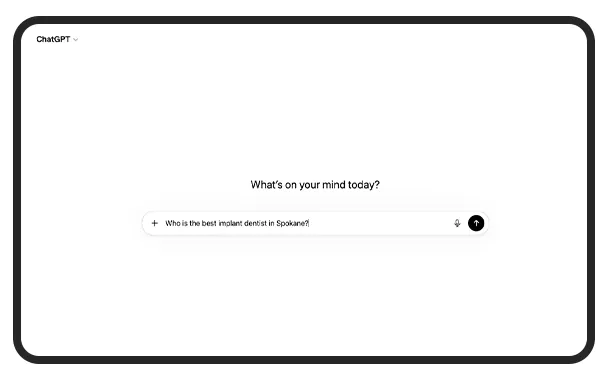
Prompt 2: "Who is the best implant dentist in [your city]?"
Prompt 3: "What dentist accepts [your insurance plan] near [your city]?"
Prompt 4: "Who offers Invisalign in [your city]?"
Prompt 5: "What's a good family dentist near [your city or zip code]?"
Run through all five. Screenshot the results. Now here's what to look for.
Did your practice name appear? Did it appear more than once? Did it appear with any context — like a description of your services or a mention of your location? Or was it completely absent?
If you're not showing up in any of those results, you're not alone. Most dental practices aren't. But the gap between those who show up and those who don't is growing, and it's growing fast.
What "Not Appearing" Actually Means
Here's where a lot of dentists breathe a sigh of relief too quickly. If you didn't show up, you might think, "Well, not that many patients use ChatGPT yet. It's probably not a big deal."
That thinking is understandable — but it's the same thinking that kept practices off Google in 2005.
When you don't appear in AI search results, it usually means one of a few things:
Your website doesn't clearly answer patient questions. AI tools like ChatGPT are built to provide confident, direct answers. They pull from sources that explain things clearly in plain language. If your website just says "We offer dental implants — call today," there's nothing for AI to work with. It doesn't know who you serve, where you're located, what makes you different, or why a patient should choose you.
Your online presence isn't consistent. If your practice name, address, or phone number varies between your website, Google Business Profile, and online directories, AI systems lose confidence in your credibility. Inconsistency reads as unreliability — even if the difference is something as minor as "Suite 100" vs. "Ste. 100."
Your content doesn't match how patients actually talk. There's a big difference between a dental website that lists "Orthodontic Services" and one that answers "How much does Invisalign cost in Atlanta?" AI search is built around conversational questions. If your content doesn't mirror how real patients phrase their concerns, you're essentially invisible to these tools.
The bottom line is this: not appearing in AI search isn't a technology problem. It's a content and credibility problem — and both are fixable.
Why Some Practices Show Up Once and Then Disappear
This is something that trips up a lot of dentists who do the test and find themselves listed... the first time. They run the same prompts a week later and their practice is gone. What happened?
It comes down to understanding the difference between training data and live search behavior.
Some AI tools — like the base version of ChatGPT without browsing enabled — are working from a snapshot of the internet that was captured months or even over a year ago. If your practice happened to be mentioned in a local news article or a well-trafficked review site during that snapshot, you might appear once. But it's essentially luck, not strategy.
Other AI tools, like ChatGPT with web browsing turned on, Google's AI Mode, or Perplexity, are pulling live results from the web in real time. These tools actively crawl current websites and reviews. This is where your ongoing content, your Google Business Profile activity, and your review volume really start to matter.
The practices that show up consistently — not just once — are the ones who've done the work to build authority across both. They have detailed, question-answering content on their websites, strong and recent reviews, and consistent information everywhere their name appears online. That combination signals to AI tools, "This is a real, credible, established practice."
The Big Difference Between SEO and AI Search (And Why It Matters for Your Practice)
If you've invested in traditional dental SEO over the years, you already understand the basics: rank for the right keywords, build backlinks, keep your site fast and mobile-friendly. That foundation absolutely still matters. Don't let anyone tell you otherwise.
But AI search adds a new layer called Answer Engine Optimization, or AEO. And the difference is more than just terminology.
Traditional SEO helps your practice appear in a list of results. Someone searches "dentist near me" and gets ten blue links. You want to be one of them.
AI search doesn't give people a list. It gives them an answer. When someone asks ChatGPT "Who's the best implant dentist in [city]?", the response might name one practice. Maybe two. Definitely not ten.
That shift changes everything about how you need to think about your website content. You're no longer just trying to rank for phrases. You're trying to be the clearest, most credible, most complete answer to the questions patients are already asking.
Patients aren't searching for "dental implant services." They're asking "How much do dental implants cost?", "Am I a good candidate for implants?", and "How long does the implant process take?" If your website answers those questions directly and clearly, you're building the kind of content that AI tools want to reference.
What to Do in the Next 30 Days if You're Invisible
Failed the test? Here's a practical starting point.
Week 1: Audit your service pages. Pick your top two or three services — maybe implants, Invisalign, and general family dentistry. Read those pages as if you're a nervous patient who just heard about the procedure for the first time. Do they actually answer your questions? Or do they just describe the service and ask you to call?
If it's the latter, you've found your starting point. Rewrite those pages to answer the real questions: Who is this for? What does the process look like? Is it painful? How long does it take? What does it cost? Do you take my insurance?
Week 2: Build out FAQ sections. Every major service page should have a structured FAQ section — not vague marketing language, but actual questions written the way a patient would ask them, followed by clear and honest answers. This format is exactly what AI search tools are designed to pull from.
Week 3: Tighten up your online consistency. Google your practice name and check every listing you can find — Google Business Profile, Yelp, Healthgrades, Zocdoc, your local chamber of commerce. Make sure your name, address, and phone number are identical everywhere. Update your Google Business Profile if it's been dormant.
Week 4: Focus on reviews. AI tools treat consistent, recent reviews as a trust signal. If you haven't been actively asking happy patients for Google reviews, now is the time to build that into your workflow. Aim for recency, not just volume.
None of this requires a technical background or a big budget. It requires intention and consistency — the same things that made good practices stand out in the Yellow Pages era, the Google era, and every marketing shift before that.
One Important Reminder About AI-Generated Content
You might be tempted to use ChatGPT to rewrite all your service pages in an afternoon. That's actually not a bad instinct — AI can be a great drafting tool. But there's a critical mistake to avoid.
Never copy and paste AI-generated content directly onto your website without reviewing and personalizing it. Generic content that doesn't reflect your voice, your city, your patients, or your actual approach to care doesn't build authority. It can actually weaken it. Patients notice when something feels like it was written by a robot for a generic dental website. AI should help you move faster, not replace the genuine expertise and care you bring to your practice every day.
Use AI to draft. Then make it yours.
The Bottom Line
AI search is not replacing Google. It's adding a layer on top of it — and that layer is growing. Right now, 37% of consumers are beginning their searches with AI tools, and 44% say AI is now their primary source for finding information. The practices that adapt early will gain a real advantage. The ones that wait will spend the next few years catching up.
The good news is that everything that makes your practice show up in AI search also makes your website better for patients. More clarity. More honest answers. More helpful content. More consistency. There's no trade-off here — it's just good marketing done right for 2026 and beyond.
So go run the test. Five prompts, two minutes. And if you don't like what you see, you now know exactly where to start.
If you failed the test, the complete 4-part process for fixing it is laid out in our free guide: How to Make Your Dental Practice Show Up in ChatGPT. It covers everything from structuring your website for AI search to the exact prompts you can use to start building better content today.
Want help evaluating where your practice stands? Our team at Firegang Dental Marketing works exclusively with dental practices on dental SEO, dental website design, and AI-ready marketing systems that work across both traditional and conversational search. We'd love to show you what's possible.
Schedule a complimentary Practice Growth Assessment with our team!