[Sample] Everyone Told Me I Wouldn't Survive. Here's the Playbook I Used Anyway.
I just opened a dental practice in Miami, Florida, one of the most competitive dental markets in the country. Two dentists, three hygienists, and a brand-new practice with zero patient base.
Everyone told me to move locations. Some told me to sell before I lost too much. The consensus was clear: you can't compete here.
They were wrong. And the reason they were wrong isn't because I outspent the competition. It's because I stopped competing with them entirely.
This is the exact playbook I used. Read it with a pen and paper.
First, Let's Name the Real Problems
Before getting into what I did, it helps to understand what most practices in competitive markets are actually up against:
- Intense marketing and patient acquisition costs
- High overhead and operating expenses
- Entrenched incumbents and DSO competition
- Staffing shortages and retention issues
- Difficulty building patient loyalty
- Reduced profitability and slower growth
These are real problems. But the bigger issue isn't the problems themselves. It's the assumptions dentists make when trying to solve them:
- Thinking marketing requires a massive budget
- Assuming your clinical work speaks for itself and keeps patients loyal
- Assuming you're no match for a corporate DSO
- Relying almost entirely on digital marketing: SEO, ads, social media
- Thinking discounting is a safe way to bring in more patients
Strip all of that away, and every patient acquisition challenge boils down to four things:
- Competition – you're fighting for the same patients as everyone else
- Reputation – there's nothing in place to confirm you're trustworthy
- Visibility – the right patients can't find you
- Retention – you're losing patients you already worked hard to win
The rest of this post is how I addressed each one.
1. Competition: Stop Fighting for the Same Patients
The Core Problem
I knew from day one I couldn't compete with DSOs and established practices head-on. The problem with going head-to-head is that everyone is doing the same thing: same offer, same channels, same patients. When your survival depends on the same pipeline as a hundred other practices, that pipeline becomes expensive and increasingly unreliable.
So I ignored the noise entirely and focused on acquiring patients who weren't in that space at all.
Tactic 1: Partner With Businesses Where Patients Are Already Investing in Their Appearance
I built a two-way referral pipeline with local businesses that serve the same type of patient, but for different needs. Think med spas, plastic surgeons, and bridal boutiques.
Here's a specific example of how this works:
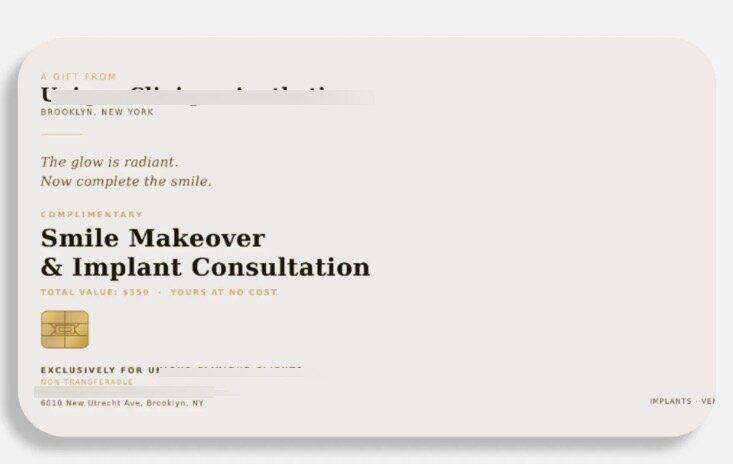
A bride receives a $300 cosmetic dental consultation voucher from her bridal boutique, presented as a complimentary gift.
- She has a hard deadline: the wedding date
- She has a strong desire to look her absolute best
- She just hasn't thought about her smile yet
I positioned myself before she ever picked up the phone to search for a dentist.
Total cost: $50 and the time it takes to walk into the boutique and introduce myself.
Tactic 2: Mail New Neighbors Before Anyone Else Does
I mail every new neighbor who recently moved into the area a smile consultation gift card along with a whitening kit.
They have no practice they're loyal to yet, which makes them the most receptive audience there is. I get in front of them before they even have a dental problem and give them an incentive they can redeem when they do.
Total cost: less than $500 for over 60 new neighbors.
Tactic 3: Micro-Influencers, But Not the Way You're Thinking
Instead of chasing big influencers or burning time on organic social media, I target specific local micro-influencers with 5,000 to 10,000 followers: mom influencers, household and kitchen creators, lifestyle accounts that mothers follow.
I invite them to the clinic for a free whitening session. When they arrive, I hand them a doctor's coat with their name embroidered on it, walk them through everything like a colleague, and take a team photo with the entire staff, with them in the center. They leave with the coat. I record every moment of the visit, then run targeted social media ads using that footage to reach mothers in the area.
Why mothers? Because they hold the highest authority over health decisions in the household. Convert the mother, and you convert her husband and her kids too.
Total cost: $1,200 covering the free session, the coat, and the ad spend.
This is how I stopped competing for the same patients as every other dentist in Miami.
2. Reputation: Securing the Booking Before They Call
Why Reputation Is the Invisible Gatekeeper
All the acquisition tactics above have a single point of failure: Google.
When a bride receives my gift card, when a new neighbor gets my mailer, when an influencer's audience sees my ad, the very first thing every single one of them does is Google my practice name.
If they find a 3-star rating, or a review count below 100, doubt creeps in. Even if they genuinely wanted to become a patient. They can't physically vouch for my clinical skills, so reviews are their only real signal. The higher the review count, the stronger the message: a lot of people have been here, and they loved it. That social proof converts hesitation into a booked appointment.
This is why I focus intensively on getting patients to leave reviews, consistently, not just at the start.
Two Methods I Use to Generate Reviews
The Manual Method: The Direct Ask
I print a QR code that leads directly to my Google review profile and place it at the front desk. Patients are simply asked to leave a review so others like them can find the practice.
The Automated Method: The Follow-Up Ask
I send an automated text 15 to 60 minutes after a patient leaves, asking them to leave a review to help others find us. It takes less than 10 minutes to set up and runs in the background without any additional effort.
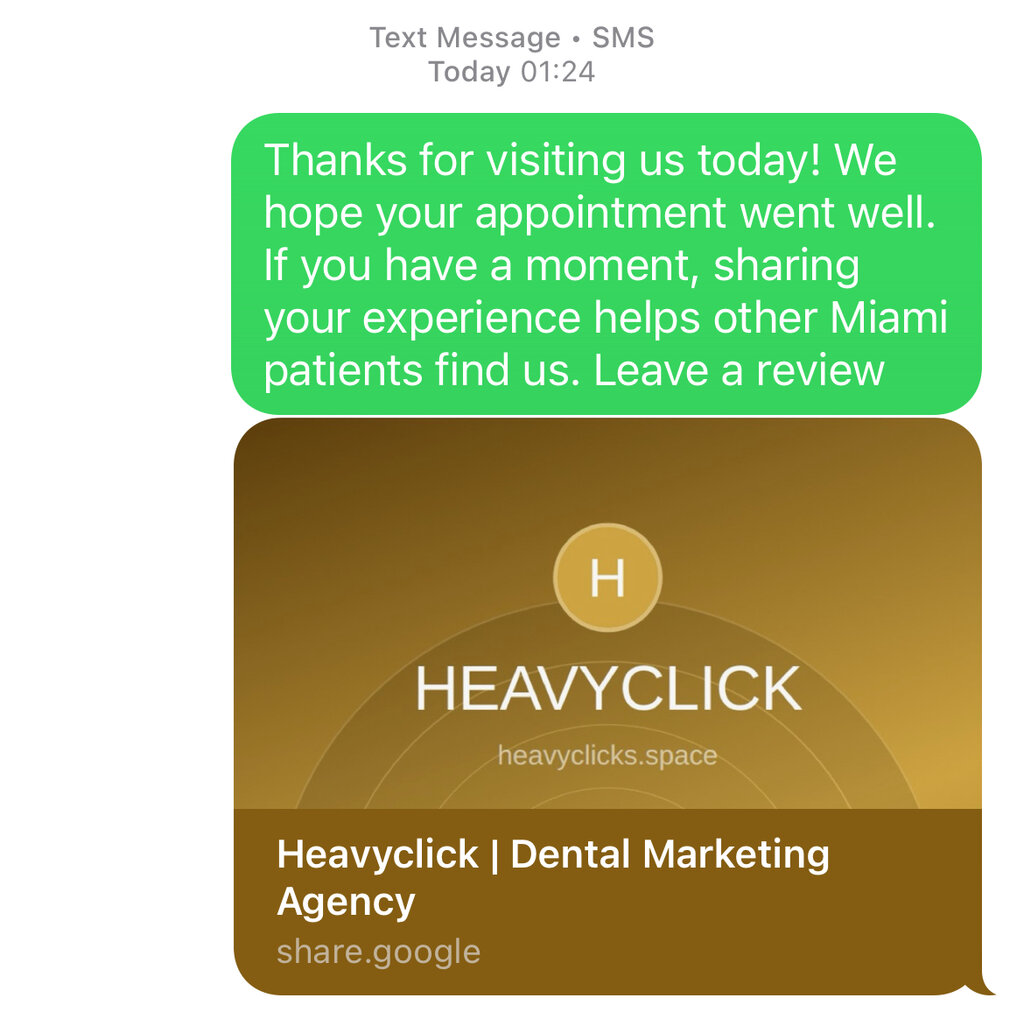
Both approaches work. But the automated method removes the awkward ask, especially when the front desk is busy or not yet trained to do it consistently.
Together, they create a steady inflow of new reviews that grow my reputation over time. So when patients who've heard of me finally decide to search, what they find reinforces their decision to book.
3. Visibility: Showing Up Where Patients Are Actually Searching
Digital vs. Physical Visibility
Most of what I covered under Competition is the physical side of visibility: getting in front of patients before they ever open a search bar. For the digital side, there are three main channels:
- Google Map Pack
- Google Ads
- Website (organic SEO)
In a competitive market, Google Ads and organic rankings are the hardest to win. They're essentially a competition of who can spend more, and DSOs win that fight every single time. That doesn't mean they're pointless, but it does mean they shouldn't be the primary focus for a new or growing independent practice.
Instead, I focus my energy where I have more control and a higher opportunity to outrank competitors: the Google Map Pack.
How the Google Map Pack Actually Works
Here's what most practices get wrong: ranking at the top of the Map Pack doesn't require the highest star rating. Google uses multiple factors to determine Map Pack rankings:
- Review velocity – how frequently new reviews are coming in
- Review recency – how recent the latest reviews are
- Review count – total volume of reviews
- Relevance – how well your profile matches the search query
- Location – proximity to the searcher
- Supporting materials – service pages, photos, Q&A, and website signals
So here's what I do: I get new reviews consistently, make sure those reviews contain relevant keywords (implants, veneers, gentle treatment, same-day emergency, etc.), grow my total review count over time, list a wide service area, and maintain a dedicated page for every service I offer.
When a patient searches "implant dentist in Miami," I show up first, because my reviews mention implants, my services include implants, my website has a dedicated implant page, and patients have been leaving reviews every week for the past six months. To Google, that signals an active, trusted practice. It rewards that signal with a higher ranking.
For the exact approach I took with my website and Google Ads setup, reach out directly at divine@heavyclicks.space and I'll walk you through it.
4. Retention: Turning Patients Into Lifers
Why Retention Deserves as Much Attention as Acquisition
It costs significantly less to keep a patient than to acquire a new one. Yet most practices pour nearly all their energy into acquisition and treat retention as an afterthought.
Here's how I approach it, and none of it is what you'd expect.
Create a Moment They've Never Had at a Dentist
Most practices mistake great retention for great clinical experience. But what truly makes a difference is doing something genuinely different. If you're just doing the same things a little better, nothing really changes: the patient still just went to the dentist.
For every new patient, I give them a doctor's coat with their name embroidered on it, take a full team photo with them, post it on social media tagging them, and call them the Doctor for the Day.
This creates a moment unlike anything they've experienced at a dental practice, probably unlike anything they've experienced anywhere. It doesn't feel like a transaction. It feels like a memory. And patients who have a memory tied to your practice don't leave easily.
Turn Retention Into a Game
I use the same psychology that casinos and betting apps are built on.
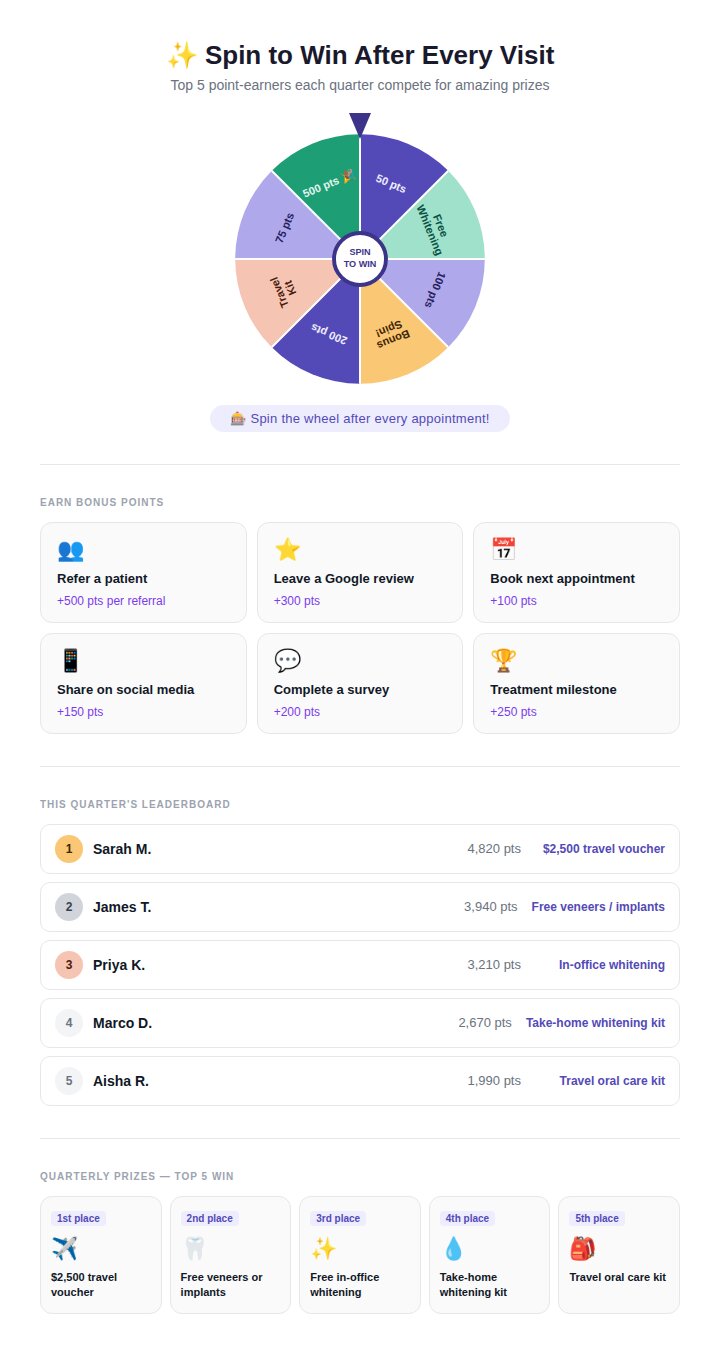
After every appointment, patients spin a wheel for random rewards, including points. The top five highest point-earners each quarter compete for:
- $2,500 travel voucher
- Free veneers or implants
- Free in-office whitening
- Take-home whitening kit
- Travel oral care kit
Now patients are returning because they're genuinely invested. They feel like they have a real shot at winning, especially as their points accumulate. Word spreads because it's fun, and referrals also earn points, turning loyal patients into active recruiters.
This costs less than two months of ad spend and delivers 5 to 10 times the return.
Gift Cards for the People They Love
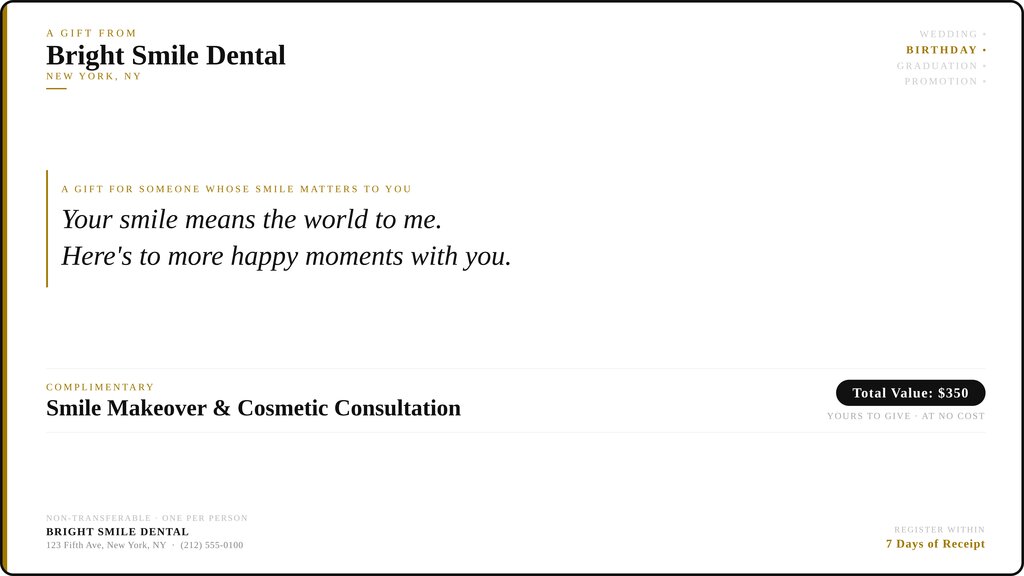
I give patients gift cards they can share with loved ones for specific life moments: weddings, birthdays, graduations, job promotions. Each card covers a cosmetic smile consultation, and it's framed as:
A gift for someone whose smile matters to you.
On the card: "Your smile means the world to me. Here's to more happy moments with you."
The effect on retention is significant, not just because I'm thinking of my patients, but because I'm thinking about the people they love. And the loved ones who come in arrive already emotionally connected to the practice, because of the moment attached to that card.
The Full Picture
None of this replaces a solid intake process or consistent patient follow-ups. Those still matter. But the four pillars above create such a strong pull that patients are more willing to forgive the occasional mistake, rather than walk out the door and look for someone new.
Capture patients where no one is competing with you. Build a reputation that secures the booking before they even call. Show up where patients are actually searching. Create moments that make you a permanent part of their story.
A Closing Thought
A fisherman arrives at the ocean and panics.
Everywhere he looks, there are boats: giant corporate trawlers, crowded fishing zones, and people fighting over the same schools of fish. He assumes the ocean is too competitive.
So he joins the crowd. He casts his net where everyone else does, competing harder and harder for the same fish.
But an older fisherman laughs and points to the horizon.
"The ocean isn't crowded," he says. "Only this small patch is."
Most fishermen stay where the fish are obvious. They chase the same schools, use the same methods, and fight over the same waters.
But the ocean is massive. There are hidden currents, untouched reefs, deeper waters, and entire species of fish the crowded boats never reach, because they're too busy competing with each other.
The smartest fisherman doesn't win by buying the biggest boat or shouting the loudest. He wins by going where others aren't looking, and becoming the boat the right fish naturally swim toward.
That is how great practices dominate competitive cities. They stop fighting for the same visible patients as everyone else, and create something people remember, talk about, and seek out, before they ever start searching.
What Happens Next Is Up to You
Some will read this and try to implement parts of it, then quickly give up.
Some will nod along and shelve it, waiting for when they might need it, and never come back to it.
Some will read it and realize they don't have the time to implement any of this, because they're too focused on running the practice itself.
All three are valid. This was written with all of them in mind.
But if you're the third type, the one who sees the value but knows execution is the bottleneck, I'd love to have a quick conversation about setting this up for your practice.
Find Out If Your Practice Is Running a Full Patient System — Or Leaving Chairs Empty?