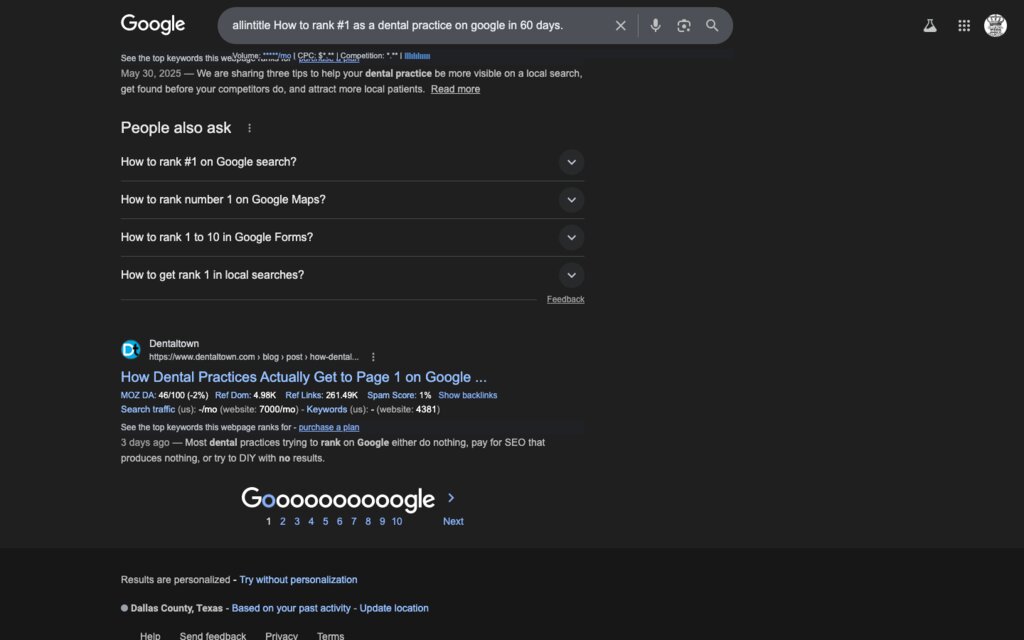
Three days ago, I published the previous post in this series on Dentaltown. As of today it's on Page 1 of Google, outranking articles from sites with Domain Authority scores 17 to 37 points higher. I wrote it using the exact method below. Keep that in mind as you read.
Let me say the quiet part out loud.
When an SEO agency tells you "Page 1 in 60 days," there are three ways that claim can be true:
1. They're ranking you for a keyword nobody searches (you're #1 but your traffic is zero)
2. They're running Google Ads and calling it organic ranking (it vanishes the moment you stop paying)
3. They actually found a keyword where the current Page 1 results are so weak that your dedicated page beats them immediately
Only the third one is real. And the third one is genuinely achievable for almost every dental practice, if you know how to find it.
This is how.
Why 60 days is possible (and why most SEO misses it entirely)
Here's what most articles about dental SEO don't tell you: Google doesn't rank websites by age. It ranks pages by relevance to the query.
For competitive head terms like "dentist Austin TX" or "dental implants Chicago," established sites with years of authority dominate. You're fighting into a wall. That takes 12 to 18 months minimum.
But for long-tail, high-intent queries like "emergency dentist open Saturday Austin," "Invisalign cost Carson City Nevada," or "dental implants vs dentures Birmingham AL," you are often not fighting anybody. Nobody has published a dedicated page targeting that exact phrase with proper on-page optimisation, schema markup, and a strong Google Business Profile behind it.
Those queries are wide open. And the patients searching them are more ready to book than anyone searching a broad term. Someone typing "emergency dentist open Saturday" isn't browsing. They're deciding right now.
The 60-day strategy isn't about beating established competitors. It's about finding the searches where there is no real competition and being the first to show up with a proper answer.
The tool that finds these keywords in 30 seconds (free, no software needed)
This is called the Keyword Golden Ratio, and it's the most underused free technique in local SEO.
Here's how it works:
Step 1: Find a specific long-tail keyword related to your services. Think treatment + location + modifier. "Invisalign cost Carson City." "Dental implants vs dentures Birmingham." "Emergency dentist open Saturday Austin."
Step 2: Check the monthly search volume using Google Keyword Planner (free). For the KGR technique to apply, the volume should be under 250 monthly searches.
Step 3: Go to Google and search: allintitle:"your exact keyword phrase"
This shows you exactly how many pages on the internet have used that phrase in their title tag, meaning they deliberately targeted it.
Step 4: If the allintitle result is under 63, you have a KGR keyword. If it's under 20, you have what I call a "vacuum": a search with real patient intent and essentially no competition.
A keyword where 180 people per month search for it and only 8 pages have targeted it in their title is not a competition. It's an empty space you fill once and own.
I've run this check for dental practices across the US. In every single local market, there are 15 to 30 keywords fitting this profile that no practice or agency has claimed yet. "Emergency dentist open Sunday [city]," "teeth whitening before wedding [city]," "dental implants financing [city]." They exist everywhere. Most agencies don't look for them because they're optimising for the big keywords that impress clients in reports, not the specific ones that actually produce fast, measurable results.
The 2-minute SERP test before you write a word
After finding a KGR keyword, do this before building the page.
Search the keyword in Google. Look at the Page 1 results and check for three things:
The Forum Flag: Are Reddit threads, Quora posts, or old forum discussions in the top results? If yes, Google is showing forums because no high-quality dedicated article exists. Your page beats them immediately upon indexing.
The Tangent Flag: Do the top results only mention your keyword in passing? They're broad articles that happen to include your phrase once, not pages dedicated to answering the specific question. A page built entirely around that one query outranks them fast.
The Ancient Flag: Are the top results from 2018 to 2021? Fresh content with proper optimisation consistently outperforms stale pages when the quality is comparable.
If you find two or three of these flags on the same keyword, you're not competing for a Page 1 spot. You're claiming an empty one.
The practices that hit Page 1 in 60 days aren't doing anything more technically sophisticated than their competitors. They're just choosing targets where the current results are genuinely weak and building one page that answers the question better than anything currently there.
On-page: the five places the keyword must appear
Once you've confirmed the keyword passes the KGR check and the SERP sniff test, the page needs to be built around it specifically. Not loosely. Not approximately. Exactly.
The exact keyword phrase goes in five places:
1. URL slug — yourdomain.com/invisalign-cost-carson-city/ Not /invisalign/. Not /services/invisalign/. The exact phrase.
2. Title tag — The exact phrase at the start. Under 60 characters. Example: Invisalign Cost in Carson City | Bright Smile Dental
3. H1 — The exact phrase must be intact in the H1. It can have words around it but the phrase itself cannot be broken.
4. Meta description — Exact phrase in the first sentence. Not the second. The first.
5. First 100 to 150 words — The exact phrase appears naturally in the opening paragraph. Answer the query immediately; don't bury the lead after 300 words of background.
None of these is optional. Missing even one weakens the on-page signal. If the allintitle count is under 10, you could rank with imperfect on-page. If it's under 63 but over 20, you need all five placements to be clean.
What the content itself needs to do
Google doesn't rank the best writing. It ranks the best solution to the searcher's problem.
For a dental keyword like "Invisalign cost Carson City," the patient's actual question is: what is this going to cost me, at a specific practice, in my city, with my insurance situation? A page that answers that directly, with a real cost range, insurance coverage specifics, financing options, and a named dentist with their Invisalign credentials, will outrank a page that says "contact us for pricing." Always.
Three rules for the content:
1. Immediate utility. If they asked "how to," give them the steps in the first paragraph. If they asked "how much," give them the number first. No 400-word history of Invisalign before the price range.
2. Format match. Search your target keyword before writing. If the Page 1 results are all numbered lists, use a numbered list. If they're short paragraphs with bolded subheads, do the same. Google has already determined which format patients prefer for that query. Match it.
3. Cover the next question. After answering the primary query, answer what they'll search for next. If they asked about Invisalign cost, they'll next ask about insurance coverage, payment plans, and how long treatment takes. Answer all three on the same page. The reader should have no reason to go back to Google.
How to track whether it's working (the 60-day clock)
Once the page is live, submit the URL immediately in Google Search Console. Don't wait for Google to find it. Manual submission cuts the indexing delay from weeks to days.
Then watch these four signals in GSC:
Days 1 to 7: URL shows as indexed in URL Inspection. If it's not indexed, you're not in the race yet.
Days 7 to 21: Impressions start appearing for the target keyword. Google is showing your page, even if it's on page 5. This is the signal that the page has been found and evaluated.
Days 14 to 45: Average position for the keyword moves. You want to see 80 to 50 to 25 over this period. If it's stuck at 80+, the page likely needs a stronger internal link from an existing page on the site.
Days 45 to 60: Position 11 to 20. This is what I call striking distance. Google is actively testing your page, showing it to users to see if they click and stay. When they do, the page gets promoted to Page 1. At this stage, add one internal link from your highest-traffic page to this new page, using the keyword as anchor text. That single link often provides the push that finalises the ranking.
The difference between this and what agencies typically do
Most dental SEO campaigns target the keywords that look impressive in reports: high volume, high competition terms. "Dentist [city]." "Dental implants." The agency publishes content targeting these, the content sits on page 4 for months, the client sees no patients from it, and eventually stops paying.
This approach is the opposite. Find the queries where the current results are weak. Build a page that answers the question better than anything there. Submit it immediately. Track the four signals. Add an internal link boost at the striking distance stage.
The result isn't a vague "Page 1 in 60 days" promise. It's a specific page, targeting a specific keyword, that you can watch move through the ranking stages in real time.
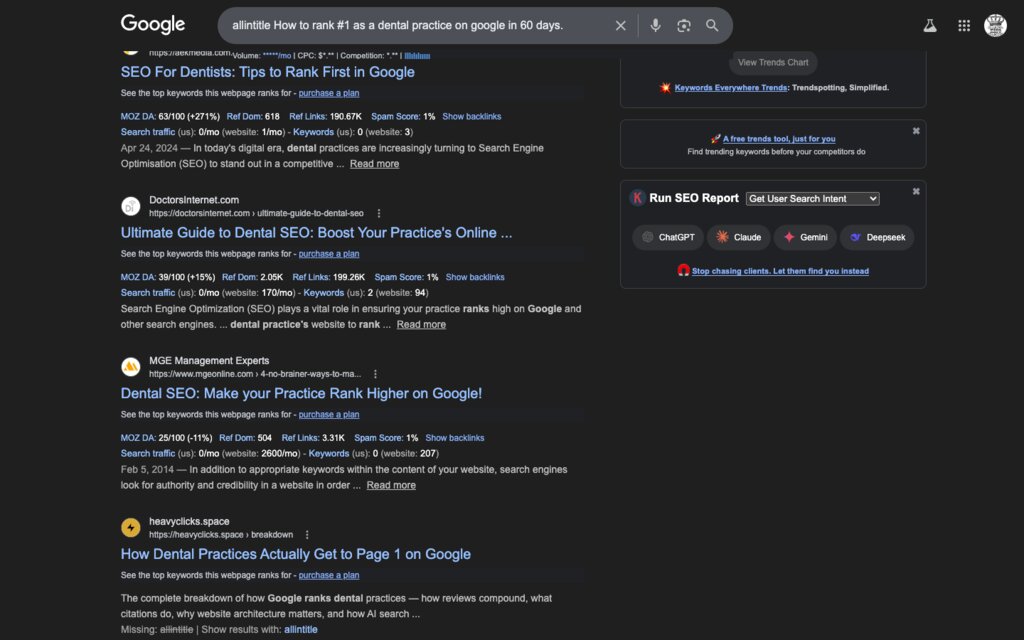
A final note on what you're looking at in that second screenshot. The Dentaltown post from this series is on Page 1. The heavyclicks.space breakdown page it links to is sitting at the top of Page 3, three days after publishing, with no backlinks and no paid promotion. Page 3 in 72 hours on a brand new page means it's already inside striking distance. One internal link addition and it moves. That's the 60-day clock running in real time.
For the full breakdown of how all four trust signals, reviews, citations, website architecture, and AI search visibility, work together to build the foundation this strategy sits on: heavyclicks.space/breakdown
If you want to know which specific keywords in your market pass the KGR check right now, and what your current site's technical foundation looks like against these standards, we run free audits. Specific findings delivered within 24 hours, no call required: heavyclicks.space/contact
And here's the previous article on How Dental Practices Actually Get to Page 1 on Google (And Why Most Never Do)
Divine is the founder of Heavyclick, a dental web studio that builds patient-converting websites with full SEO architecture, automated review generation, and AI search visibility. Results guaranteed or we work free.