Does Blue Light Whiten Teeth Without Gel? A Manufacturer's Technical Breakdown for Dental Practices
A patient sees the blue LED mouthpiece, watches it glow for 15 minutes, and asks a reasonable question:
If the light is doing the whitening, why do I need the gel?
For conventional blue-light whitening systems, the answer is straightforward: the light is not the bleaching agent.
Hydrogen peroxide or carbamide peroxide does the chemical whitening. Blue light may accelerate or modify that reaction in systems designed for light activation, but it does not reliably replace peroxide-based gel.
That distinction sounds simple. In practice, it affects almost every decision a dental practice makes about a whitening system—from gel concentration and treatment time to LED wavelength, patient expectations, restorations, sensitivity, and device sourcing.First, Separate the Light From the Whitening Chemistry
The phrase blue light teeth whitening without gel is attractive because it suggests a cleaner, simpler treatment: no peroxide, no gel management, just light.
The evidence is less convenient.
Peroxide-based bleaching works because reactive oxygen species generated from hydrogen peroxide interact with pigmented molecules within tooth structure. Carbamide peroxide functions as a slower-release source of hydrogen peroxide.
Light does not provide those bleaching molecules.
Clinical and laboratory research has evaluated light-only approaches, particularly with violet LEDs, but light alone has generally produced less whitening than peroxide-based bleaching. One randomized clinical study found violet LED alone produced substantially less whitening than LED used with carbamide peroxide.
For blue LED systems used around the 460 nm range, the practical conclusion for a dental practice is even simpler:
Do not treat the LED as the active whitening ingredient.
Think of the system as two separate components:
Bleaching chemistry: changes tooth color.
Light delivery: may influence the rate or efficiency of that chemistry depending on the gel formulation, wavelength, output, and protocol.
That distinction prevents patients from developing unrealistic expectations about inexpensive LED-only mouthpieces.
What Actually Whitens the Tooth?
Most professional and take-home chemical whitening systems rely on either hydrogen peroxide or carbamide peroxide.
Hydrogen peroxide is the more direct bleaching agent. It can penetrate enamel and dentin and generate reactive species that oxidize chromophores responsible for discoloration.
Carbamide peroxide breaks down into hydrogen peroxide and urea, releasing peroxide more gradually. This slower behavior is one reason carbamide peroxide has traditionally been common in longer-duration take-home protocols.
The difference is not that one chemical "works" and the other does not. It is mainly a matter of concentration, release kinetics, exposure time, formulation, and intended protocol.
Clinical studies have shown effective whitening with both hydrogen peroxide and carbamide peroxide across different concentrations and application times.
For the clinician, the important point is that the gel formulation remains the primary driver of bleaching.
A sophisticated light cannot compensate for an inappropriate gel, poorly controlled soft-tissue exposure, or an unsuitable treatment protocol.
How Does Blue Light Activate Whitening Gel?
This is where teeth-whitening marketing often becomes too simplistic.
You will often hear that blue light "activates peroxide." That can be true in a properly designed light-activated system, but not every peroxide gel responds to blue light in the same way.
Some formulations contain pigments, catalysts, nanoparticles, or other photo-responsive components designed to absorb light energy. In those systems, illumination can accelerate peroxide decomposition or contribute photochemical and photothermal effects.
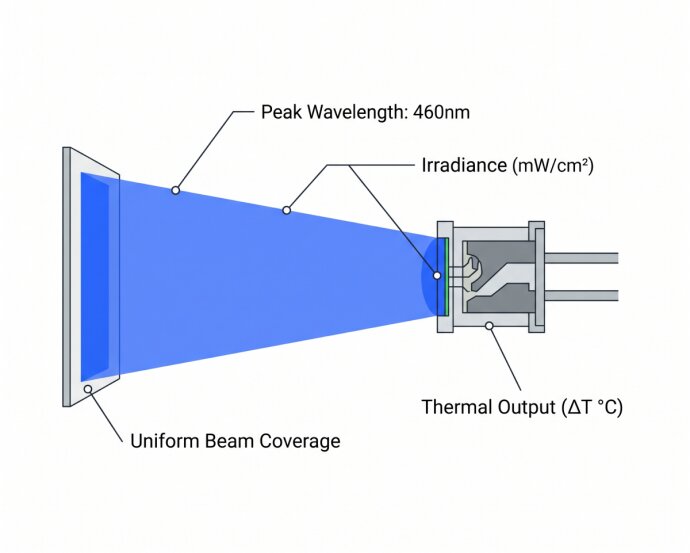
Blue LED systems used in whitening research commonly operate near 460 nm, and commercial systems often fall around the 460–470 nm region. A study examining photo-thermal acceleration, for example, used a 460 nm LED and discussed its interaction with bleaching material.
But wavelength alone does not determine performance.
A manufacturer also needs to control spectral output, irradiance, exposure time, beam geometry, distance from the teeth, temperature rise, and compatibility with the whitening formulation.
This is why asking whether a device "has blue LEDs" tells a practice very little.
A more useful question is:
What optical protocol was the device engineered to deliver, and what gel was that protocol designed to work with?
There is also an important evidence caveat. A systematic review of in-office bleaching found that light activation did not consistently improve final whitening efficacy over light-free peroxide bleaching, particularly with conventional high-concentration peroxide gels.
So blue light should not be marketed as a guaranteed performance multiplier.
Its value is formulation- and protocol-dependent.
Blue Light Wavelength Matters, but 460–470 nm Is Not a Magic Number
Dental practices sometimes compare whitening lamps by wavelength alone.
One supplier lists 460 nm. Another lists 465 nm. A third advertises 470 nm.
That does not automatically make one system better.
The blue light wavelength for teeth whitening is only one engineering parameter. Output stability and the way the light interacts with the gel are just as important.
A system nominally rated at 465 nm may have a relatively broad spectral distribution. Another may have a tighter peak. Two lamps using the same LED wavelength can also deliver very different irradiance at the tooth surface because of optical geometry, distance, lens design, or LED quantity.
From a device-selection perspective, practices should therefore ask for more than a wavelength specification.
Useful technical information includes:
A published wavelength is a starting point, not evidence of clinical performance.
Blue LED vs UV vs Halogen: They Solve the Same Problem Differently
Dental whitening has used several light-source technologies over time.
Their engineering characteristics are quite different.
Click the image to view the sheet.
Halogen systems illustrate why more optical energy is not automatically better. Experimental measurements have found conventional halogen bleaching lamps can produce greater temperature increases than LED sources.
And across LED, halogen, and laser-assisted protocols, recent evidence reviews continue to question whether adding light consistently improves whitening efficacy enough to justify the additional complexity.
For practices evaluating equipment, the safer technical principle is:
Choose a light source because it fits a validated gel-and-device protocol—not because a brighter lamp sounds more powerful in a brochure.
Professional and Take-Home Gel Concentrations Are Not Interchangeable
One of the biggest differences between chairside whitening and take-home whitening is the bleaching protocol.
Professional studies commonly evaluate higher-concentration hydrogen peroxide systems, including formulations around 25–40%, because the treatment is applied for shorter periods under controlled soft-tissue protection.
Take-home protocols commonly use lower-concentration hydrogen peroxide or carbamide peroxide for longer or repeated exposure.
Clinical trials demonstrate how different those protocols can be. One study achieved effective home bleaching using 4% hydrogen peroxide for 30 minutes per day over four weeks, while other trials have evaluated 10% carbamide peroxide for several hours per day.
There is no universal "professional concentration" or "home concentration" that applies in every jurisdiction. Legal limits, product labeling, supervision requirements, and formulation characteristics vary by market.
What matters is that the LED unit and gel protocol are designed as a system.
Manufacturers offering OEM and private label solutions can supply dental practices with properly calibrated LED units paired with clinically tested gel formulations, allowing practices to offer branded take-home kits without developing hardware in-house.
That model can work well, but only if the practice treats gel specifications and LED specifications as linked technical requirements rather than two unrelated products placed in the same box.
Natural Teeth or Restorations? Set Expectations Before Whitening
This is one of the most useful conversations to have before treatment.
Blue light whitening does not make veneers, crowns, or composite bonding respond like natural tooth structure.
Peroxide bleaching can change natural tooth color substantially. Restorative materials behave differently.
Ceramic veneers and crowns generally do not bleach to match newly whitened enamel. Composite resins can show surface or color changes after peroxide exposure, but the effect is material-dependent and is not a predictable method for clinically lightening an existing restoration. Research also shows bleaching agents can alter physical or surface properties of some restorative materials.
The practical problem is shade mismatch.
A patient with an anterior crown matched to their pre-whitening tooth shade may complete bleaching successfully and then discover that the natural teeth are lighter while the restoration has remained essentially unchanged.
This is not a failure of the whitening lamp.
It is a treatment-planning issue.
Practices should identify visible veneers, crowns, fillings, and bonding before bleaching and explain whether restoration replacement or shade adjustment may be needed afterward.
Side Effects: The Gel Usually Matters More Than the Blue Light
The two most common problems associated with peroxide whitening are temporary tooth sensitivity and gingival irritation.
The mechanism is not simply "the light made the tooth sensitive."
Peroxide concentration, exposure time, diffusion through enamel and dentin, baseline sensitivity, and soft-tissue contact all influence the patient's experience.
That said, light parameters still matter.
A randomized study using 35% hydrogen peroxide with a 460 nm LED found higher immediate sensitivity in quadrants exposed to light, although the measured changes were reversible.
Other studies and reviews have also found that adding light can increase sensitivity without necessarily producing a superior long-term color result.
For the device manufacturer, this creates a clear engineering responsibility:
Avoid unnecessary optical and thermal exposure.
For the practice, it creates a clinical responsibility:
Do not assume that a more intense whitening lamp provides a better patient outcome.
How Often Can Blue Light Whitening Be Used Safely?
There is no responsible universal answer such as "three times per week."
The safe schedule depends on the gel concentration, application time, product instructions, previous whitening exposure, baseline sensitivity, restorations, and whether treatment is professionally supervised.
Clinical whitening protocols range from short in-office applications to daily at-home bleaching for several weeks. For example, controlled studies have evaluated daily 4% hydrogen peroxide for four weeks and 10% carbamide peroxide regimens lasting several weeks.
Those study protocols should not be converted into a generic recommendation for every LED kit.
For dental practices, the practical rule is simpler:
Follow the validated device-and-gel protocol and the manufacturer's instructions for use.
If a patient develops significant sensitivity or gingival irritation, increasing treatment frequency because "the LED is safe" misses the source of the problem.
The chemistry and total exposure still matter.
Build the Technical File Before You Buy the Device
Practices often evaluate a whitening lamp visually first.
Is the stand stable?
Does the mouthpiece look modern?
Does it have enough LEDs?
Those questions matter, but they come later.
Before selecting an LED whitening system, request the technical documentation that allows the device to be evaluated as equipment rather than décor.
At minimum, a professional buyer should know:
• wavelength and spectral tolerance,
• irradiance at the intended treatment distance,
• treatment area and beam uniformity,
• timer and automatic shut-off behavior,
• operating temperature or thermal validation,
• intended compatible gel formulations,
• cleaning and infection-control instructions,
• electrical and battery specifications where applicable,
• labeling and intended use,
• and applicable regulatory documentation.
A practice planning a private-label take-home system should also clarify who is responsible for the gel, tray or mouthpiece, packaging, labeling, and final kit claims.
Those responsibilities should be settled before artwork is approved.
FDA Clearance: What Dental Practices Should Actually Verify
"Is it FDA cleared?" sounds like a simple supplier question.
For whitening lights, the regulatory answer is more nuanced.
FDA has historically cleared tooth-whitening light systems under 21 CFR 872.6475, described as a heat source for bleaching teeth, product code EEG. Older 510(k) records include LED whitening systems such as BriteWhite and Absolute White Light.
However, FDA's current device exemption database lists devices under 21 CFR 872.6475 as Class I and generally 510(k)-exempt, subject to the applicable exemption limitations.
That means practices should not use "has a 510(k) number" as the only test of whether a whitening light is legitimately marketed.
Instead, verify:Click the image to view the sheet.
FDA also recognizes ISO 28399 / ANSI ADA 136 for external tooth-bleaching products, although that standard specifically excludes auxiliary devices such as whitening lights from its scope.
For procurement teams, that is exactly why regulatory documentation should be reviewed at the finished-product level, not reduced to a logo printed on a supplier brochure.
What to Look for in an OEM or Private-Label Whitening Device Manufacturer
Whitening equipment is easy to make look convincing.
Blue LEDs, a glossy housing, a timer, and a mouthpiece can create a product that photographs well.
The harder question is whether the manufacturer can explain the device technically.
A serious supplier should be able to answer how the optical output was measured, how the treatment distance was defined, how heat is controlled, what gel chemistry the system was designed around, and what regulatory classification applies in the intended market.
For private-label programs, ask whether the supplier can maintain the same optical specification across production batches.
For professional systems, ask about replaceable components, cleaning protocols, serviceability, and duty cycle.
For take-home kits, evaluate ergonomics, battery behavior, charging protection, automatic shut-off, mouthpiece materials, packaging, and how easily the patient can reproduce the intended treatment position.
Experience matters more than a long feature list.
A manufacturer that responds to every technical question with "we can customize it" has not actually answered the question.
What Blue Light Whitening Can—and Cannot—Deliver
A well-designed LED whitening system can support a controlled peroxide-bleaching protocol.
It can provide repeatable illumination.
It can be engineered around a photo-responsive formulation.
It can improve the usability and branding of an in-office or take-home whitening program.
What it cannot do is change the basic chemistry of bleaching.
Blue light cannot make peroxide unnecessary simply because the device is brighter or more expensive.
It also cannot reliably whiten crowns, veneers, or bonding to match natural teeth.
And the research does not support telling patients that light activation always produces a better final shade than peroxide alone. The benefit varies by formulation and protocol, and several systematic evaluations have found little or no long-term improvement with light activation.
That is not an argument against LED whitening systems.
It is an argument for using them for the right technical reason.
Questions Worth Asking Before You Commit to a Whitening System
Before a dental practice purchases or private-labels a blue-light whitening device, these questions usually reveal more than the product brochure:
1. What is the measured peak wavelength and spectral range?
2. What irradiance reaches the teeth at the specified working distance?
3. How uniform is the optical output across the treatment area?
4. Which peroxide formulations was the system designed or tested to work with?
5. What temperature rise occurs during a full treatment cycle?
6. What timer, shut-off, and exposure-control features are built in?
7. How are mouthpieces or patient-contact components cleaned or replaced?
8. What side-effect and sensitivity guidance accompanies the gel protocol?
9. What FDA classification and product code apply to the exact finished device?
10. If this is a private-label kit, who controls the technical file, labeling, packaging, and gel compatibility?
The best supplier is not necessarily the one that answers "yes" fastest.
It is the one that can show how the answer was verified.
The Bottom Line
So, does blue light whiten teeth without gel?
For conventional blue-light teeth-whitening systems, no—the gel is the bleaching agent.
Hydrogen peroxide or carbamide peroxide provides the chemistry that changes tooth color. Blue LED light, commonly engineered around the 460–470 nm region in whitening systems, may accelerate or modify that reaction when the formulation and optical protocol are designed to work together.
That does not mean every whitening treatment needs light.
It does mean that if a practice chooses to use an LED system, the device should be evaluated as part of a complete bleaching protocol—not as a stand-alone whitening mechanism.
For clinicians, this makes patient communication easier.
For procurement teams, it makes technical comparison more meaningful.
And for practices developing branded whitening kits, it creates a much better question than "How many LEDs does this device have?"
Ask instead:
What exactly was this light engineered to do?
References
1. Maran BM, Burey A, de Paris Matos T, Loguercio AD, Reis A. Different light-activation systems associated with dental bleaching: a systematic review and network meta-analysis. 2019.
2. Gottenbos B, et al. Insights into blue light accelerated tooth whitening. 2021.
3. Qi F, et al. Effect of photo-thermal acceleration on in-office bleaching. 2021.
4. Meireles SS, et al. Efficacy and safety of 10% and 16% carbamide peroxide tooth bleaching. 2008.
5. Terra RMO, et al. Effect of daily usage time of 4% hydrogen peroxide on at-home dental bleaching. 2021.
6. U.S. Food and Drug Administration. 21 CFR 872.6475, Heat Source for Bleaching Teeth; Product Code EEG; Medical Device Exemptions and 510(k) Requirements.
7. ISO 28399:2021 / ANSI ADA Standard No. 136-2022. Dentistry — External Tooth Bleaching Products.
Author Bio
Rio Wu works in R&D at Kaiyan Medical, an OEM/ODM manufacturer of light therapy and phototherapy devices. Learn more about Kaiyan's teeth whitening technology.