Dental practices that rely on anesthesia-dependent procedures know the frustration of a coverage gap. When a provider cancels or moves on, the schedule stalls fast. More practices are now turning to locum tenens anesthesia staffing as a reliable way to keep things moving without committing to a full-time hire.
The challenge is not always clinical. Most dental anesthesia providers are competent and careful. The gap tends to show up on the staffing side, quietly, until a procedure gets delayed or a surgical block goes unfilled. And in a practice that depends on anesthesia-driven cases for a real share of its revenue, that gap is not a minor inconvenience.
Dental Procedures and Anesthesia
Oral and maxillofacial surgery, full-mouth reconstructions, implant placements under sedation, and pediatric dentistry that requires general anesthesia. These are not fringe cases. They happen every day in dental offices and outpatient surgical centers across the country.
For some patient populations, particularly pediatric patients, those with severe dental phobia, or those undergoing complex extractions, anesthesia is not optional. It is necessary for the procedure to happen at all.
Yet many dental practices treat anesthesia coverage the same way they treated it a decade ago. A single relationship with one anesthesia provider, maybe a local group, or an independent contractor. It works until it does not. A provider retires, relocates, or takes on another contract, and suddenly the schedule falls apart.
The Staffing Problem Most Practices Do Not Plan For
Here is a scenario that plays out more often than the industry talks about. A busy oral surgery center builds its entire anesthesia workflow around one anesthesiologist. That provider has worked reliably for three years. Then they take a position at a hospital. The practice now has a scheduling gap, an unhappy patient list, and no clear path to filling it fast.
It is not a crisis of clinical quality. It is a staffing crisis. And unlike other staffing gaps in a practice, anesthesia is highly specialized. You cannot backfill with a general hire. You need credentialed, experienced professionals who can step in without a lengthy orientation period.
This is where the model of temporary and flexible anesthesia coverage has started crossing into the dental and oral surgery space in a meaningful way. Practices that once thought of locum arrangements as a hospital-only solution are now using them to cover gaps that their traditional model simply cannot handle.
How Locum Tenens Anesthesia Works in Dental Settings
The locum tenens model is straightforward. A practice that needs anesthesia coverage connects with a staffing agency that specializes in placing anesthesia professionals. The agency matches the practice with qualified providers, handles credentialing verification, and coordinates availability. The provider comes in, covers the schedule, and the practice keeps moving.
For dental and oral surgery settings specifically, this matters because anesthesia needs are often episodic rather than constant. A pediatric dental practice might only need a dedicated anesthesia provider two or three days a week. An oral surgeon might need full coverage during a busy quarter and lighter coverage in slower months. The locum model fits that pattern better than a traditional full-time hire.
It also removes the pressure of building a long-term employment relationship around a role that the practice may not need at full capacity year-round. For smaller practices, especially, that flexibility has real financial value.
What Dental Practices Should Look for in an Anesthesia Staffing Partner
Not every staffing agency understands the dental environment. Most are built for hospital settings, ICUs, and surgical centers with very different patient flows and protocols. A dental office has its own rhythms, its own equipment, its own patient communication style. When evaluating a staffing partner, a few things matter.
First, verify that the agency places providers with experience in outpatient and dental settings specifically. A CRNA who has only worked in a hospital OR may need a meaningful adjustment period before they are fully effective in a chair-side dental environment.
Second, ask about turnaround time. One of the main reasons practices turn to staffing agencies is speed. If a provider cancels two days out, can the agency find a qualified replacement quickly? That capability varies significantly between agencies.
Third, understand the credentialing process. In dental settings, credentialing requirements may differ from what a hospital-based provider is used to. A good agency handles this proactively rather than leaving it to the practice to manage on its own.
Finally, look for an agency that focuses exclusively on anesthesia. Generalist healthcare staffing firms sometimes offer anesthesia placements as one of many service lines. Firms that specialize only in anesthesia tend to have deeper provider networks and faster placement times.
CRNA vs Anesthesiologist: Choosing the Right Coverage for Your Practice
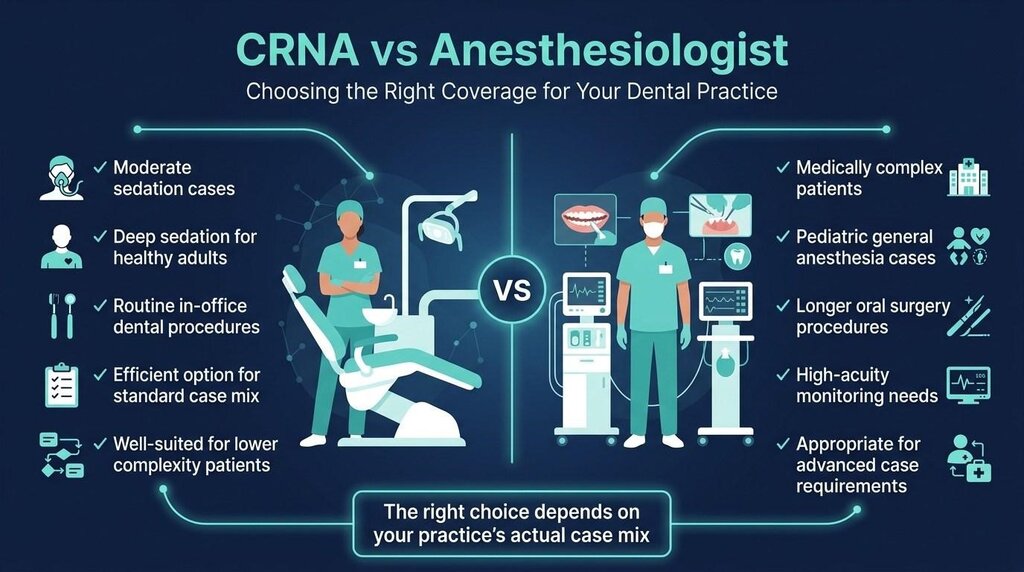
Dental practices sometimes ask whether they need an anesthesiologist or whether a CRNA can handle their cases. The honest answer is that it depends on the cases.
For most in-office sedation in a dental context, including moderate sedation and deep sedation cases in healthy adult patients, a CRNA is well within their scope of practice and can provide excellent coverage.
For more complex cases involving medically compromised patients, pediatric patients requiring general anesthesia, or longer oral surgery procedures, having an anesthesiologist either on-site or in a supervising role may be more appropriate.
A good anesthesia staffing partner will help a practice think through this based on their actual case mix, rather than defaulting to one answer or the other.
The Hidden Cost of Gaps in Anesthesia Coverage
Practices often underestimate the downstream cost of an unplanned anesthesia gap. The most visible impact is the rescheduled procedures and the patient calls. But there are less visible costs too.
When procedures get delayed, surgical blocks go unfilled. Staff is still on the schedule. Fixed overhead keeps running. In a practice that relies on anesthesia-dependent procedures for a meaningful share of revenue, a two-week gap is not a two-week inconvenience. It is a material financial hit.
Beyond revenue, there is reputation. Patients who get rescheduled for reasons outside their control do not always come back. In dental care, where long-term patient relationships drive retention, that matters more than most practices account for.
Practices that have been through an unplanned gap usually become very intentional afterward about having a backup option in place, whether that is a secondary relationship with an independent provider or an agreement with a staffing agency that can move quickly when needed.
1MAC Anesthesia: Built Specifically for Anesthesia Staffing
1MAC Anesthesia is a staffing company that focuses exclusively on anesthesia placements. The company was built specifically to address the kind of coverage challenges described throughout this article, working with healthcare facilities, surgical centers, and specialty practices that need reliable anesthesia professionals without the delays that come with general healthcare staffing.
What separates a dedicated anesthesia staffing firm from a generalist agency is the depth of its provider network. 1MAC maintains relationships with both CRNAs and anesthesiologists, giving practices flexibility in choosing the coverage type that fits their cases and their budget.
For practices that need consistent, scheduled placement rather than one-off gap coverage, 1MAC also offers anesthesiologist staffing arrangements structured around a practice's ongoing schedule rather than treated as emergency fill-ins.
The exclusive focus on anesthesia also means faster credentialing, better-matched providers, and staff who understand the difference between hospital and outpatient environments.
Planning Ahead Is the Better Strategy
The practices that handle anesthesia staffing well are rarely the ones scrambling to fix a problem after it happens. They are the ones who thought through the scenario in advance.
That does not mean keeping a full-time backup on standby. It means having a relationship with a staffing partner before the gap happens. Knowing who you would call, what the process looks like, and how fast they can turn around a placement.
For dental practices where anesthesia coverage is a regular part of the schedule, that kind of preparation is worth building into the practice management plan the same way you would plan for equipment maintenance or staff leave coverage.
Anesthesia is one of the most specialized roles in any clinical setting. Treating its staffing with the same seriousness is not overcautious. It is just good practice management.