You brush twice a day. You use a premium electric toothbrush. Your dentist still finds plaque between your teeth. Here's why — and what to actually do about it.
If you're reading a dental health website, chances are you take oral care seriously. You've invested in a quality toothbrush. You might even time your two minutes. You care about your gums, you notice when they bleed, and you've probably spent more time thinking about your brushing technique than most people spend thinking about their teeth at all.
So why does your hygienist still reach for the scaler?
The answer lies in a simple geometric truth that the oral care industry has spent decades dancing around: your toothbrush bristles cannot physically enter the spaces between your teeth. Not the premium model. Not the one with 62,000 vibrations per minute. Not the one with the diamond-shaped bristle pattern. None of them.
The average interdental space — the narrow gap where two adjacent teeth touch — measures between 0.1 and 0.5 millimeters across at its tightest point. A single nylon bristle, even the ultra-fine variety, has a tip diameter of approximately 0.12 to 0.2 millimeters before it flexes. Once you factor in the tufting density required for effective surface cleaning, bristles simply cannot penetrate the interproximal zone. They deflect. They glance off the convex tooth surface. They clean the cheek-facing side, the tongue-facing side, and the biting surface — and they leave the spaces between teeth entirely untouched.
This isn't a design flaw. It's a physical constraint. And it matters because over 80% of dental caries originate precisely in these interdental spaces — the very areas bristles cannot reach.
The Floss Gap
The dental profession's answer to this problem has been consistent for generations: floss. And to be clear, correctly performed interdental cleaning with traditional floss remains an excellent preventive measure. The evidence base supporting mechanical interdental cleaning is robust.
The problem is adherence.
Studies consistently show that only about 30% of adults floss daily. More troublingly, of those who do, only approximately 12% use correct technique — gently curving the floss around each tooth in a C-shape and sliding it below the gumline, rather than simply snapping it through the contact point. The remaining 88% are going through motions that provide minimal clinical benefit while believing they've done their due diligence.
The combined result: roughly 40% of adults have some degree of interdental gingivitis — inflammation of the gum tissue between teeth — independent of how well they brush. You can have immaculate brushing habits and still have bleeding gums in the interproximal areas. It's not a hygiene failure. It's a delivery failure.
Rethinking the Mechanism
This is the context in which RANVOO's AirJet technology enters the conversation — not as a better toothbrush, but as a fundamentally different approach to interdental cleaning.
The core innovation is conceptually elegant: instead of trying to force a solid object (a bristle, a piece of floss, a plastic pick) into a narrow space, use a fluid to carry the cleaning action there instead. Fluids conform to geometry. They flow around curves. They find narrow openings passively, without requiring the user to locate and target them. This is why water flossers exist. But AirJet takes the concept several steps further, into genuine fluid dynamics territory.
The system generates a continuous stream of microbubbles — each tens of microns in diameter — through a pressurization chamber built into the toothbrush handle. These aren't the large, short-lived foam bubbles you see when brushing normally. They are a dense, engineered suspension of gas in liquid, small enough to travel into interdental spaces and stable enough to deliver energy where it's needed.
The brush head itself is shaped using principles from computational fluid dynamics. It exploits the Coanda effect — a well-known phenomenon where a fluid jet naturally attaches to and follows a curved surface. When the microbubble stream exits the brush head and encounters a tooth, it doesn't spray randomly. It wraps around the contour and flows into the nearest available crevice. The user brushes normally. The fluid does the navigating.
What Happens When the Bubbles Arrive
This is where the technology separates itself from a standard water flosser. When microbubbles reach the confined environment of an interdental space and contact plaque biofilm — the sticky bacterial matrix that adheres to tooth surfaces — they undergo acoustic cavitation: an asymmetric collapse that generates a microscopic but high-energy liquid jet directed at the tooth surface.
This is the same physical principle used in industrial ultrasonic cleaning, where cavitation bubbles remove contaminants from precision components. The difference is one of energy calibration. AirJet's system operates at deliberately low mechanical frequencies — a maximum of 21,600 brush strokes per minute, compared to the 31,000 to 62,000 typical of premium sonic brushes — because the heavy lifting of interdental cleaning is done by the cavitation effect, not by abrasive bristle contact. The bristles handle surface polishing. The bubbles handle the gaps. Two mechanisms, decoupled and independently optimized.
The clinical result cited by the manufacturer is a 97% plaque removal rate with Grade 1 cleaning efficiency — the highest classification under standardized dental cleaning performance testing. For context, traditional sonic toothbrushes alone typically remove less than 40% of interdental plaque.
Why This Matters for Gum Health
If you have sensitive gums — if they bleed when you brush, if your dentist has mentioned gingivitis or early recession, if you've been told to "brush more gently" — the low-frequency design philosophy of a system like AirJet deserves your attention.
High-frequency brushing (above 30,000 strokes per minute) delivers significant mechanical energy to gingival tissue. For healthy gums, this is generally well-tolerated. For inflamed, fragile, or receding gums — which describes a substantial portion of the adult population — it represents cumulative microtrauma. Brushing harder or faster is exactly the wrong response to gum sensitivity. But the underlying problem — inadequate interdental cleaning — still needs to be solved.
By separating the interdental cleaning mechanism (cavitation) from the surface cleaning mechanism (bristle contact), AirJet allows both tasks to be optimized without compromise. The bristles can operate at a lower, gum-friendly frequency — paired with a narrow 12° oscillation angle and 99.99% end-rounded tips — while the fluid system independently delivers the interdental cleaning performance that high-frequency brushing was attempting, and largely failing, to achieve.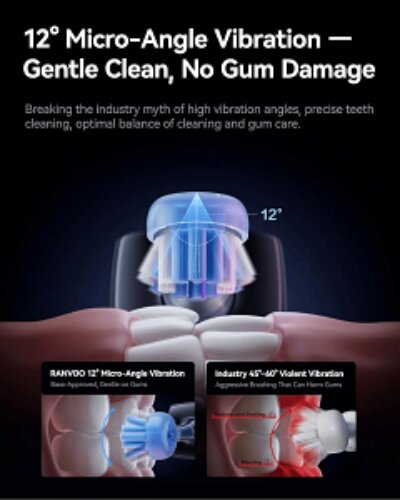
This is not a theoretical distinction. It is the practical difference between a device that cleans well at the expense of gum comfort, and one that was engineered to do both from the start.
Is This a Replacement for Flossing?
The honest answer — the one you'd want from a dental health resource — is nuanced.
If you are among the small minority who floss daily with correct C-shaped technique, reaching below the gumline on both sides of every interproximal space, you are already doing what the evidence supports. Continue. No device can improve on mechanically excellent flossing.
But if you are among the 70% who don't floss daily, or the 88% whose technique could use improvement, the practical calculus shifts. A technology that automatically delivers microbubble cleaning into interdental spaces every time you brush — without requiring additional tools, additional time, or learned technique — will, in real-world conditions, substantially outperform the flossing routine you intend to maintain but don't.
That is the honest value proposition: not "better than flossing when flossing is done perfectly," but "better than what actually happens in the vast majority of bathrooms every morning."
The Takeaway
Oral care technology has spent decades optimizing a mechanism — bristle-on-enamel friction — that reached its ceiling long ago. The surfaces bristles can reach are not where the clinical problems concentrate. The next frontier is delivery: getting the cleaning action into the spaces that matter most, in a way that people will actually sustain.
Whether or not AirJet specifically is the answer for you depends on your individual oral health profile, your current routine, and your dentist's guidance. But the question it poses is one worth sitting with: if 80% of cavities start where your brush can't reach, what exactly is your brush doing for you?