Rubber Dam Clamp Fracture and the $654,000 Aspen Dental Verdict
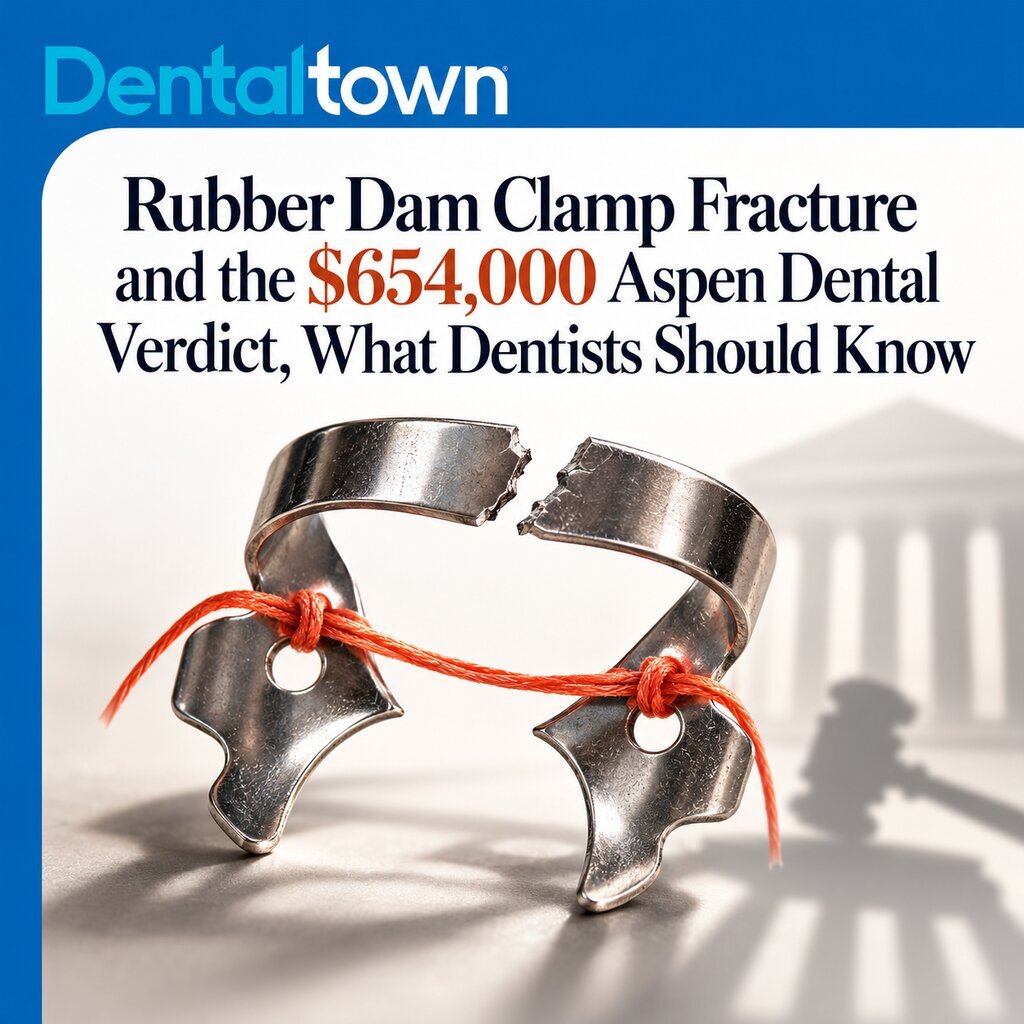
A reported $654,264 jury verdict in Glynn County, Georgia, has put an obscure piece of dental technique under a very bright light. According to two Georgia plaintiff law firms reporting the case, a rubber dam clamp fractured during a root canal at an Aspen Dental office in Brunswick in 2023. A metal fragment reportedly went down the patient’s throat, leading to four days in the hospital and two procedures under anesthesia. The jury reportedly awarded $54,264.24 for medical expenses and $600,000 for pain and suffering. Roden Law separately lists a 2026 Glynn County dental malpractice verdict of about $654,000 involving a swallowed metal fragment from a broken rubber dam clamp. The basic event and verdict are strongly corroborated, although the actual court docket, signed verdict form, trial transcript, jury instructions, and Aspen Dental response have not yet been located publicly.
The headline circulating among dentists is much simpler. Dentist loses $654,000 because the rubber dam clamp was not tied with floss through both holes. That version is memorable, frightening, and probably too neat. A jury verdict resolves one dispute based on the evidence and expert testimony presented in that courtroom. It does not create a national rule requiring every dentist to secure every clamp in one specific way. Georgia malpractice law asks whether a clinician exercised the degree of care and skill ordinarily employed by the profession under similar circumstances. A bad result alone does not establish negligence, and the existence of a safer technique does not automatically make every alternative negligent.
Still, the plaintiff’s argument cannot be dismissed as something invented after the accident. Dentistry has recognized the danger of rubber dam clamp ingestion for more than 50 years. A 1971 report in The Journal of the American Dental Association described a six year old girl who swallowed a rubber dam clamp and required esophagoscopy for removal. The authors recommended attaching dental floss or suture material to the clamp so it could be retrieved if it moved toward the pharynx. Decades later, the University of Oklahoma College of Dentistry was instructing endodontic students that all rubber dam clamps should be ligated with floss before placement in the mouth.
Harty’s Endodontics in Clinical Practice goes further. The textbook explains that clamps can fracture, particularly across the bow, and recommends attaching floss to both sides by passing it through the holes on either side. The reasoning is simple. If the clamp breaks across the bow and only one side is secured, the other fragment may remain free. Securing both sides provides control of both pieces during placement. That recommendation existed years before the reported 2023 incident.
There is also credible professional support for another technique. Eugene Pantera, DDS, MS, writing in Decisions in Dentistry, described placing the clamp and dental dam as an assembled unit so the clamp remains outside the dam material. In that configuration, the dam itself can help retain the clamp if it becomes dislodged, and floss may be unnecessary. Pantera also acknowledged that clamps tend to fracture at the bow and noted that if floss is used as the safety mechanism, both sides need to be secured. The broader clinical question may therefore be less about whether every dentist must always use floss and more about whether the isolation method protects the patient if the clamp dislodges or fractures.
The American Association of Endodontists is unequivocal on the broader issue. Dental dam isolation is the standard of care for nonsurgical endodontic treatment, and the AAE specifically identifies protection from ingestion and aspiration of instruments, materials, and irrigants as part of the rationale. Its position statement does not say that every clamp must be flossed or that floss must pass through both holes. That distinction matters. Dental dam use is formally identified as the standard of care. Clamp security appears to allow more variation.
The materials science also complicates the assumption that a broken clamp must have been old or worn out. A 2002 report in the International Endodontic Journal documented catastrophic fracture of a brand new clamp during its first clinical use, with investigators tracing the crack to an engraved marking that created a stress concentration in the bow. A 2018 study found that repeated simulated use and steam sterilization through 300 cycles did not reduce clamp tensile strength. Earlier work demonstrated stress corrosion cracking associated with mechanical loading and sodium hypochlorite exposure. Clamp failure is uncommon, but it can result from manufacturing defects, corrosion, mechanical stress, or other factors that may not be visible before placement.
That is where this case becomes useful to practicing dentists. Rare events feel theoretical until one happens. Once the patient is hospitalized, the jury is no longer asking how often clamps fracture. It is hearing whether the risk was known, whether a simple precaution existed, how long that precaution would have taken, and whether the injury was the very event the precaution was intended to prevent. A small operatory decision can look very different when examined after a serious injury.
The safest interpretation is also the least dramatic. Georgia has not established a nationwide rule that every rubber dam clamp must be tied through both holes. The available literature does show that clamp ingestion and fracture have been recognized hazards for decades, that respected educational materials recommend floss ligation, and that Harty’s specifically recommends securing both sides. It also shows that alternative isolation methods exist in which the dam itself provides retention. What becomes difficult to defend is having no plan for the possibility that the clamp may dislodge or break.
For risk management, the practical decision is straightforward. If floss is your retrieval strategy, securing both sides of a metal clamp during placement is a low cost precaution supported by professional literature. If you use another accepted method in which the dental dam itself reliably captures the clamp and any fragments, use it deliberately and consistently.
If a ten second precaution could prevent a four day hospitalization, what is your protocol?
Join the Conversation!
Verdict and case reporting
Roden Law, 2026 Glynn County Dental Malpractice Verdict https://rodenlaw.com/case-results/
Endodontic standards and rubber dam safety
American Association of Endodontists, Dental Dams Position Statement https://www.aae.org/specialty/wp-content/uploads/sites/2/2024/06/DentalDams_PositionStatement_v2.pdf
Harty’s Endodontics in Clinical Practice, 7th Edition https://shop.elsevier.com/books/hartys-endodontics-in-clinical-practice/chong/978-0-7020-5835-6
University of Oklahoma College of Dentistry, Endodontic Clinic Manual https://dentistry.ouhsc.edu/Portals/1328/assets/Documents/Current%20Students/Manuals/EndoClinicManualClassof2020.pdf
Isolation in Endodontics, Decisions in Dentistry https://decisionsindentistry.com/article/guest-editorial-isolation-endodontics/
Rubber dam clamp ingestion and fracture research
Rubber Dam Clamp Ingestion, an Operative Risk: Report of Case https://pubmed.ncbi.nlm.nih.gov/5280053/
In Vivo Fracture of a New Rubber Dam Clamp https://pubmed.ncbi.nlm.nih.gov/12196226/
Effect of Repeated Sterilization on the Tensile Strength of Rubber Dam Clamps https://pubmed.ncbi.nlm.nih.gov/29793571/
Effect of Various Irrigant and Autoclaving Regimes on the Fracture Resistance of Rubber Dam Clamps https://pubmed.ncbi.nlm.nih.gov/9206417/
Georgia malpractice law
Georgia Code § 51-1-27, Recovery for Medical Malpractice Authorized https://law.justia.com/codes/georgia/title-51/chapter-1/section-51-1-27/